managed it services phoenix: Power your business
Are you trying to grow your Phoenix business while constantly putting out IT fires? Switching to managed IT services offers a smarter, more cost-effective path than relying on a traditional in-house team. It's about swapping unpredictable IT crises for a steady, expert partnership that's invested in your success.
Why Phoenix Businesses Are Outsourcing Their IT

Think of your company like one of the fantastic restaurants in the Roosevelt Row Arts District. To get your food to customers, you could buy your own fleet of delivery trucks, hire full-time drivers, and juggle all the insurance, fuel, and maintenance that comes with it.
Or, you could partner with a dedicated delivery service that handles all the logistics for a predictable fee. It's more efficient, less of a headache, and lets you focus on making great food.
That's the fundamental idea behind managed IT services. Instead of building and maintaining a costly internal IT department, you bring on a specialized provider as a partner. This is much more than just having someone on call when a computer acts up; it’s a strategic decision to hand over the management, maintenance, and security of your entire technology stack.
From Reactive Fixes to Proactive Strategy
Many Phoenix businesses are still stuck in a "break-fix" cycle—they only call for IT help when something goes wrong. That approach is a recipe for downtime, lost productivity, and unexpected costs. A managed service provider (MSP) flips that reactive model completely on its head.
An MSP offers a proactive partnership focused on preventing problems before they ever start. This strategic shift turns your IT from a reactive cost center into an asset that fuels your growth. Instead of just patching problems, a true partner provides:
- Continuous Monitoring: They keep a 24/7 watch on your networks and systems, spotting and resolving issues before they can disrupt your workday.
- Robust Cybersecurity: They implement sophisticated security measures to defend your sensitive data from a constant barrage of threats.
- Strategic Guidance: They offer expert advice on how technology can help you work more efficiently, serve clients better, and get a leg up on the competition.
This approach is catching on. The global managed services market was valued at USD 335.37 billion and is expected to hit USD 731.08 billion by 2030, with North America accounting for over 33% of that revenue. As reported by Grand View Research, this explosive growth shows just how much value businesses see in outsourcing their complex IT needs.
A dedicated MSP becomes your outsourced Chief Information Officer (CIO), making sure your technology directly supports your business goals. They handle the technical headaches so you can focus on what you do best: running your business.
By partnering with a provider of managed IT services in Phoenix, local companies get access to a deep bench of expertise and advanced tools that would be too expensive to maintain on their own. You can explore our comprehensive IT services to see exactly how this partnership can benefit your organization.
The Real Benefits of Managed IT for Phoenix Companies
Partnering with a managed service provider (MSP) is about more than just having someone to call when your tech breaks. It's a fundamental shift that brings real financial, operational, and strategic gains, giving you a serious edge in the competitive Phoenix market. Let's dig into what this actually looks like day-to-day.
Financial Predictability And Cost Control
The first thing most businesses notice is the move away from unpredictable, and often huge, capital expenses (CapEx). Instead, you get a stable, predictable monthly operating expense (OpEx). No more surprise five-figure bills for a fried server. Just a consistent monthly fee that covers your technology from top to bottom.
This model is a game-changer for budgeting. You can plan your finances with far more accuracy, freeing up cash that would otherwise be sitting around for an IT emergency. That money can go right back into the things that actually make you money—marketing, hiring top talent, or developing new services.
By converting volatile IT costs into a fixed monthly expense, you gain superior control over your budget. This financial stability allows for more confident and strategic long-term planning, removing the guesswork from one of your most critical operational costs.
Before we go further, let's break down the core differences between handling IT yourself and bringing in a managed services partner.
Comparing In-House IT vs Managed IT Services
| Aspect | Traditional In-House IT | Managed IT Services (MSP) |
|---|---|---|
| Cost Structure | High upfront CapEx for hardware/software; ongoing OpEx for salaries, training, and unpredictable repair bills. | Predictable monthly OpEx fee. No large, unexpected capital outlays. |
| Expertise & Staffing | Limited to the knowledge of your hired staff. Access to specialized skills (e.g., cybersecurity, cloud) requires expensive new hires. | Access to a deep bench of specialists across multiple disciplines without the overhead of individual salaries. |
| Availability | Typically limited to standard business hours (9-to-5, Monday-Friday). After-hours support is rare or very costly. | 24/7/365 monitoring and support. Issues are often resolved before the next business day begins. |
| Operational Focus | Often reactive, spending time "putting out fires" and responding to immediate user problems. | Proactive maintenance and monitoring. The goal is to prevent problems from ever happening. |
| Strategic Input | Focused on keeping current systems running. May lack the bandwidth or broad market view for strategic planning. | Acts as a strategic partner, advising on technology roadmaps, security trends, and efficiency improvements. |
As you can see, an MSP fundamentally changes the role IT plays in your business—from a cost center you have to manage into a strategic asset that works for you.
Operational Excellence Through Proactive Maintenance
The old "break-fix" approach is a disaster waiting to happen. It’s like waiting for your car’s engine to seize on the Loop 101 during rush hour before finally calling a mechanic. By then, the damage is done, your day is ruined, and the repair bill is painful.
A managed services model is the complete opposite. Think of it as having a dedicated pit crew performing regular, scheduled tune-ups. Your MSP monitors your systems 24/7, spotting and fixing potential problems long before they can bring your business to a halt.
This proactive stance crushes unexpected downtime. Your team stays productive because the tools they rely on just work. It transforms IT from a constant headache into the reliable engine your operations depend on. A huge part of this is building the right foundation, which is why understanding different cloud hosting and managed services options is so critical for a resilient business.
Strategic Focus On Core Business Growth
Every minute your team spends wrestling with a printer, rebooting a glitchy app, or worrying about a phishing email is a minute they aren't spending on growing your company. When you offload the day-to-day IT grind, you give that time and focus back to your people.
You hired your team to sell, to create, to innovate, and to take care of your customers—not to be part-time tech support. When you partner with a provider of managed IT services in Phoenix, you're reclaiming their most valuable resources: time and brainpower.
This is where the real magic happens. Your MSP worries about cybersecurity threats, data backups, and network performance so your leadership can concentrate on market strategy and client relationships. This focus can even unlock efficiencies in other departments; for instance, you can realize key accounts payable automation benefits when your underlying tech is expertly managed, making every part of your business run smoother.
Navigating Arizona's Cybersecurity and Compliance Demands

If you're running a business in Phoenix—especially in healthcare, finance, or law—you know that compliance isn't just a box to check. It's woven into the very fabric of your daily operations. Regulations like HIPAA, FINRA, and SOC 2 are non-negotiable. Falling short can mean crippling fines, lawsuits, and a loss of client trust that you may never recover.
For companies without a dedicated compliance officer, the complexity of these rules can feel like a crushing weight.
This is exactly where a seasoned provider of managed IT services in Phoenix steps in. They're not just your IT support team; they become your security and compliance partner, translating dense regulatory language into practical, technical safeguards that protect your sensitive data.
Think of it like this: your managed service provider (MSP) builds a modern fortress around your company's most valuable asset—its data. It’s a multi-layered defense system built to stop threats from every possible direction.
Building Your Digital Fortress
A truly strong security posture isn't about one single piece of software. It’s about creating integrated layers of defense that work in concert. A skilled MSP constructs this fortress with a few key elements.
- The Guards (24/7 Threat Monitoring): Like guards patrolling the castle walls, expert security teams watch your network around the clock. They use sophisticated tools to spot suspicious activity and investigate potential threats long before they can do any real damage.
- The Surveillance System (Endpoint Detection and Response): Every single device, from a partner's laptop to your main server, is a potential doorway for an attacker. Endpoint Detection and Response (EDR) solutions are like high-tech security cameras on every one of those doors, monitoring for any sign of a breach and allowing for an immediate lockdown.
- The Gatekeepers (Controlled Access): Strong access controls, particularly multi-factor authentication (MFA), make sure only authorized people can get to sensitive information. It’s the digital equivalent of needing multiple keys and a secret password just to get into the vault.
This layered strategy is crucial for staying a step ahead of constantly evolving threats. It shifts your security from a passive, wait-and-see approach to an active, always-on defense.
A great MSP doesn’t just install security software and then walk away. They manage, monitor, and fine-tune your defenses continuously, treating your data security with the seriousness it deserves.
Proactive Threat Hunting And Rapid Response
Today's cyberattacks move incredibly fast. By the time an automated alert goes off, it's often too late. That's why top-tier security includes proactive threat hunting—the practice of actively searching for hidden threats inside your network that might have slipped past the first line of defense. It's the difference between waiting for the fire alarm and having a fire marshal actively inspecting the building for hazards.
And when an incident does happen, a clear, well-rehearsed incident response plan is everything. Your MSP should have a protocol to immediately:
- Isolate the affected systems to keep the threat from spreading.
- Eradicate the malicious code or intruder from your network entirely.
- Recover your systems from clean backups to get you back online with minimal downtime.
- Analyze the incident to understand how it happened and strengthen your defenses against it happening again.
This kind of rapid, systematic response is what minimizes damage, protects your reputation, and keeps your business running.
Aligning Technology With Industry Regulations
For businesses in regulated fields, every technology decision has to be made with compliance in mind. A specialized MSP gets this. They already know the specific technical controls required by different mandates.
For example, a medical practice handling protected health information (PHI) must have a partner that provides HIPAA-compliant cloud hosting and managed services. This ensures that all patient data is encrypted, stored, and accessed according to strict federal law.
The growing need for this expertise is clear from market trends. The U.S. managed services market is currently valued at an estimated USD 69.55 billion and is projected to rocket to USD 116.25 billion by 2030. This growth is fueled by the sheer complexity of modern IT and the absolute necessity for advanced cybersecurity. As detailed in recent industry analysis, MSPs are shifting from simple support to strategic partners who offer sophisticated services to meet these new demands.
By partnering with the right MSP, Phoenix businesses can transform the overwhelming challenge of cybersecurity and compliance into a strategic advantage, securing both their data and their future.
Making the Cloud Work for Your Phoenix Business
The cloud is a lot more than just a place to store files these days. For any growing Phoenix company, it’s the backbone of a scalable, secure, and flexible operation. But all that power can feel out of reach without the right guide. A skilled IT partner translates complex cloud technologies into practical tools that solve real business problems.
Many leaders hear terms like "VDI" or "hybrid cloud" and tune out, thinking they're just for giant corporations. The truth is, a local provider of managed IT services in Phoenix can put these systems to work for you, securing your remote team and making sure your business can weather any storm.
Your Office, Accessible from Anywhere with VDI
Think about how you stream a movie on Netflix. The movie file isn’t actually on your TV; it lives on a powerful server far away, and you’re just accessing it through your screen. Virtual Desktop Infrastructure (VDI) operates on the exact same principle, but for your entire work computer.
With VDI, your desktop—all your applications, files, and personal settings—runs on a high-performance server tucked away in a secure data center. Your employees can then log into that desktop from any device, anywhere they can get an internet connection.
This setup comes with some game-changing benefits:
- Airtight Security: Since no data is ever actually stored on an employee's laptop or home PC, a lost or stolen device is no longer a data breach crisis. Everything stays safe in the data center.
- Simple, Centralized Management: Instead of juggling hundreds of individual computers, your IT partner manages a single "golden image" of the company desktop. An update or new piece of software is installed once, and everyone gets it instantly.
- True Remote Freedom: Your team gets the exact same work experience whether they're in the office, at home, or on the road. This consistency is a huge boost to productivity.
Finding the Right Cloud Model for Your Business
Not all clouds are built the same, and a good MSP will help you find the right fit. For Phoenix businesses that prioritize security and control, the conversation usually comes down to two models: private and hybrid clouds.
A private cloud is like owning your own house. All the computing resources—the servers, the storage, everything—are dedicated 100% to your organization. This delivers the highest possible level of security and control, making it the go-to choice for companies in healthcare, finance, or law with strict compliance mandates.
A hybrid cloud is more like owning a house but tapping into the city's power grid during peak demand. You keep your most sensitive data and core applications safe in your private cloud, but you connect to a public cloud (like Microsoft Azure) for less critical tasks or to handle sudden traffic spikes. It’s a fantastic balance of security, flexibility, and cost-effectiveness.
Choosing the right cloud strategy isn't about buying a product. It's about aligning the technology with your specific business goals, security posture, and budget. A great IT partner designs a solution that fits you, not the other way around.
Managed Colocation: A Secure Vault for Your Servers
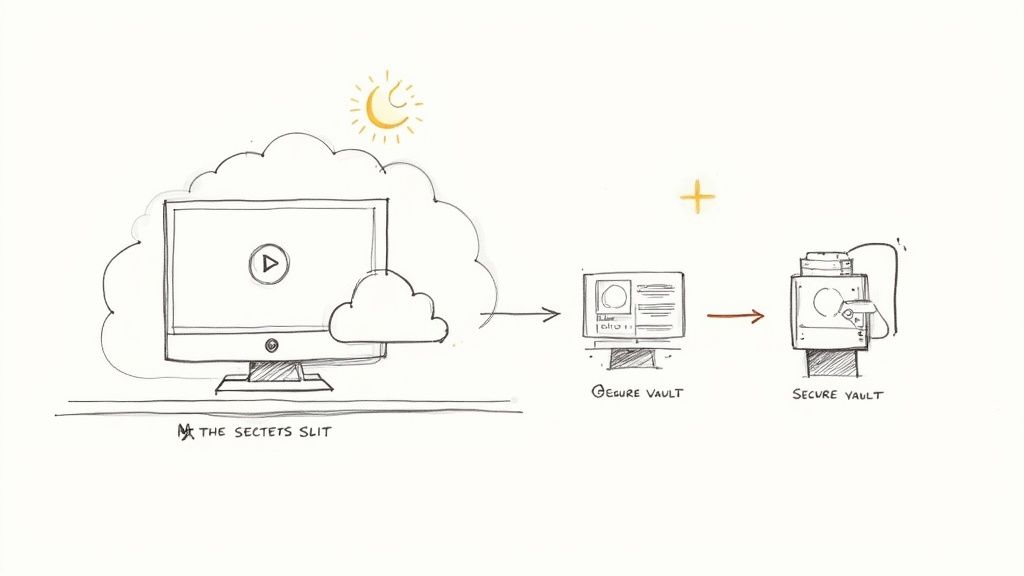
What if you've already invested in your own server hardware but your office closet isn't cutting it for power, cooling, or security? This is the perfect scenario for managed colocation. Think of it as moving your servers out of the back room and into a high-security bank vault.
You still own all your equipment, but your IT provider houses it in their professional-grade data center. They handle the redundant power, industrial cooling, fast internet connections, and physical security. Most also offer "remote hands" services to perform physical tasks for you, so you never have to make a late-night drive to the data center.
As businesses in Phoenix look to modernize and scale, leveraging the cloud often involves navigating complex transitions; understanding data center migration best practices is crucial for success with a skilled IT partner.
This shift toward outsourced, expert-led IT is driving massive growth. The global managed services market was valued at around USD 297.20 billion and is projected to skyrocket to USD 878.71 billion by 2032, largely because of the urgent need for better cybersecurity and cloud integration.
Choosing the Right Managed IT Partner in Phoenix
https://www.youtube.com/embed/USivzw8oeCM
Picking a provider for managed IT services in Phoenix is a huge decision, one that will ripple through every part of your business for years to come. This isn't about hunting for the cheapest quote. It’s about finding a true partner who gets your vision, your industry, and the unique challenges of operating in the Valley.
The right choice can become a massive competitive advantage, putting you on the fast track for growth. The wrong one? It's a recipe for constant frustration, downtime, and unnecessary risk.
You have to be methodical here. You're not just buying a service; you're handing over the keys to a critical piece of your company. That means looking past the slick sales pitch and digging into what they can actually do, how they operate, and whether they are genuinely invested in your success. A great partner has the technical chops, understands the Phoenix business scene, and provides support that feels like an extension of your own team.
Your Vetting Checklist: Essential Questions to Ask
Before you even glance at a contract, it’s time to play investigator. You need to come prepared with sharp, specific questions that peel back the marketing fluff and get to the core of their capabilities. A high-quality IT partner won't just tolerate this scrutiny—they'll welcome it.
Here’s a table outlining the critical questions every Phoenix business should be asking.
Vetting Your Potential Phoenix MSP
| Category | Essential Question to Ask | Why It Matters |
|---|---|---|
| Local Presence | "Is your primary support team actually based here in Phoenix, or are my calls routed to a national helpdesk?" | Proximity matters. You need a team that understands local business challenges and can be on-site quickly when a remote fix isn't an option. |
| Industry Expertise | "Can you give me specific examples of how you've helped other Phoenix companies in my industry, like healthcare or finance?" | You're looking for proof they understand your specific compliance rules, workflows, and operational headaches—not just generic IT problems. |
| Technical Bench Strength | "What kind of certifications do your engineers hold? Are they experts in technologies like Microsoft Azure or VMware?" | This isn't just about badges. It shows they invest in their team's skills and have proven expertise in the systems you rely on. |
| Strategic Approach | "How do you help us think ahead? What's your process for proactive planning and making sure our tech supports our business goals?" | A great partner does more than just fix what's broken. They should be talking about technology roadmaps, quarterly business reviews, and helping you budget for the future. |
| Security Philosophy | "Walk me through your standard security stack. What tools and processes do you use for endpoint protection, email security, and threat monitoring?" | Their answer reveals the maturity of their cybersecurity practice. A vague response is a major red flag in today's threat environment. |
Asking these questions helps you quickly separate the serious contenders from the pretenders. It forces them to demonstrate real, tangible value beyond a simple price list.
Decoding the Service Level Agreement (SLA)
The Service Level Agreement (SLA) is the rulebook for your relationship. It’s the single most important part of your contract, yet it’s often glossed over or completely misunderstood. This document is a legally binding promise, and you have to read every word.
Where do most businesses get tripped up? They fixate on the wrong metric. It's the classic confusion between response time and resolution time.
Response Time: How quickly the provider promises to acknowledge your support ticket and start looking at it.
Resolution Time: How quickly they promise to actually fix your problem.
A provider might brag about a "15-minute response time," which sounds amazing on paper. But if their contract gives them eight hours to resolve a critical server outage, that initial quick reply doesn't do you much good. Always, always prioritize providers who offer clear and aggressive resolution time guarantees tied to the severity of the issue.
Key SLA Metrics You Can't Ignore
A solid SLA isn't about fluff; it's about accountability. It should lay out specific, measurable commitments that protect your operations. If the language is vague, walk away.
Here are the non-negotiable metrics your SLA must clearly define:
- Uptime Guarantee: This is the percentage of time your critical systems are guaranteed to be online and working. Look for 99.9% or higher for anything essential, like servers or core network infrastructure.
- Resolution Times: The clock is ticking. The SLA must define the maximum time allowed to fix issues, broken down by severity level (e.g., Critical, High, Medium).
- Business Hours: What hours are considered "standard support"? This should, at a bare minimum, align with your company's actual operating hours.
- After-Hours Support: What happens when a crisis hits at 2 a.m.? The SLA must detail the process and costs for emergency support. True 24/7/365 availability for critical issues should be standard.
- Penalties for Failure: What happens if they don't hold up their end of the bargain? A good SLA has teeth, outlining service credits or other compensation if they fail to meet their promises.
At the end of the day, choosing the right provider of managed IT services in Phoenix comes down to trust. By asking the tough questions and dissecting the SLA, you can forge a partnership that doesn’t just put out today’s fires but helps you build a more resilient and successful business for tomorrow.
Mapping Your Smooth Transition to a New IT Provider
Changing IT providers feels like a big deal. For most Phoenix business owners I talk to, the number one fear is disruption—that nagging worry that the switch will bring business to a grinding halt, leaving your team unable to work and your customers in the dark.
But a professional handover isn't about crossing your fingers and hoping for the best. It’s a meticulously planned project, orchestrated by experts to be virtually invisible to your day-to-day operations. A top-tier provider of managed IT services in Phoenix knows how to protect your productivity and will walk you through a proven, structured process to make it happen seamlessly.
The Four Phases of a Seamless Migration
A successful move from one IT environment to another hinges on one thing: a rock-solid plan. It's all about communication and step-by-step execution. We break it down into four clear stages.
- Discovery: It all starts with a deep dive. Your new IT partner gets under the hood of your current setup, mapping out every server, piece of software, user account, and network pathway. The goal is to understand exactly how your business ticks.
- Planning: Once they have the full picture, the migration team crafts a detailed project plan. This isn't just a simple to-do list; it outlines specific timelines, who's responsible for what, and—most critically—a complete rollback plan.
- Execution: This is the "go time." The actual migration is almost always done after hours or over a weekend to cause zero disruption to your workday. The team follows the plan to the letter, moving data, reconfiguring systems, and getting user access ready.
- Support and Handover: The job isn’t done when the migration is complete. Your new provider should have dedicated support—either on-site or a direct line to an engineer—for "day one" to tackle any small questions or hitches immediately. This ensures your team feels confident and can get right back to work.
A rollback plan is your ultimate safety net. It's a pre-defined strategy to instantly revert to your old systems if any critical, unforeseen issues arise during the migration. This ensures that, no matter what, your business will be fully operational on Monday morning.
The Critical Role of Pre-Launch Testing
Before anyone flips the final switch, rigorous testing is an absolute must. This goes way beyond just making sure a few files open. It's about putting the new environment through its paces to ensure every single piece of your business technology works just as it should.
Here's what that testing should always cover:
- Application Functionality: Confirming all your core software—whether it’s your accounting package or specialized industry tools—launches and runs perfectly.
- Data Integrity Checks: Verifying that every bit of migrated data is present, uncorrupted, and accessible to the correct people.
- User Access Validation: Making sure every employee can log in with their usual credentials and get to the exact files and applications they need to do their job.
This is the phase that separates a smooth, professional transition from a chaotic, frustrating one. By catching and fixing potential issues behind the scenes, you ensure your team has a productive first day with their new IT partner.
Common Questions About Phoenix Managed IT Services
Even after seeing all the benefits, it's completely normal to have a few questions before you commit to a new IT strategy. Let's tackle some of the most common things Phoenix business owners ask when they're thinking about partnering with a managed service provider.
How Much Do Managed IT Services Cost in Phoenix?
Most providers in Phoenix operate on a straightforward monthly fee, usually priced per user or per device. This simple model is a game-changer for budgeting, turning unpredictable capital outlays into a consistent, manageable operating expense.
While costs can vary, this approach almost always delivers more bang for your buck than maintaining an in-house IT staff. You get to skip all the hidden expenses—salaries, benefits, continuous training, and surprise repair bills—and gain access to an entire team of specialists for what often amounts to less than the cost of hiring a single IT generalist.
Is My Business the Right Size for an MSP?
If you're a small or medium-sized business, you're right in the sweet spot. Managed IT is perfect for companies that are big enough to rely heavily on technology but not quite large enough to justify building out a dedicated, multi-person IT department. An MSP gives you access to enterprise-grade tools and expertise without the enterprise-level price tag.
A professional provider will walk you through a clear, structured process to ensure a smooth transition.
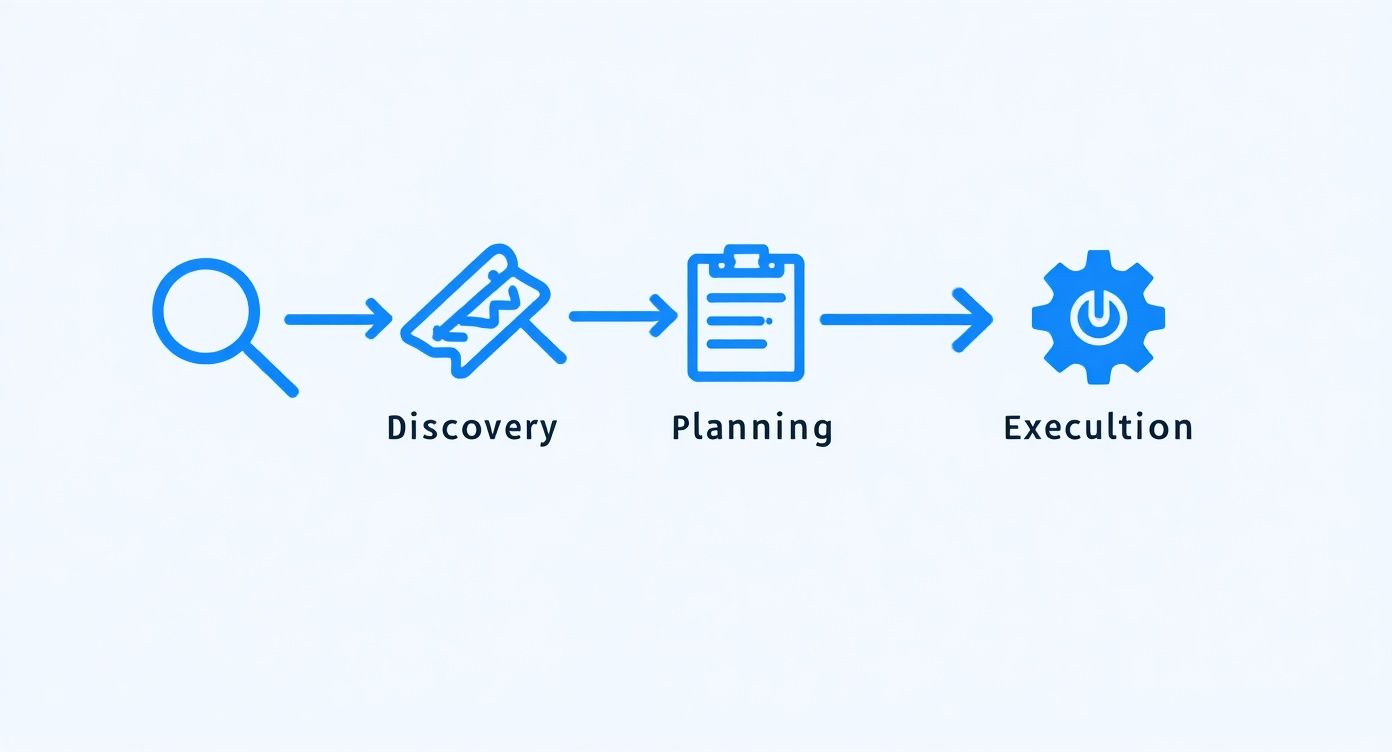
This methodical approach ensures nothing gets missed, moving from initial discovery to full implementation with as little disruption to your daily operations as possible.
How Secure Is My Data with a Third-Party Provider?
This is probably the most important question you can ask. The answer might surprise you: your data is often far more secure with a reputable MSP than it would be on your own. Security isn't just a feature for them; it's the foundation of their entire business.
These providers invest in and manage advanced security protocols that are typically out of reach for most small businesses. Think of it this way:
- Contractual Safeguards: Your relationship is governed by a legally binding Service Level Agreement (SLA) that explicitly defines their security obligations to you.
- Compliance Expertise: They live and breathe complex regulations like HIPAA and FINRA, so you don't have to.
- Advanced Security Stack: They deploy sophisticated tools like enterprise-grade firewalls, endpoint detection and response (EDR), and 24/7 security monitoring.
A true professional partner doesn't just maintain your security—they significantly upgrade it beyond what an internal team can realistically achieve.
Ready to modernize your IT, ensure compliance, and focus on your clients with confidence? Armour Cloud provides secure, reliable managed IT services designed for Phoenix businesses. Explore our managed services today.
Article created using Outrank