what is colocation data center? Benefits and use cases
So, what exactly is a colocation data center? Think of it as a specialized, high-security apartment building for your company's servers and IT hardware. You bring your own equipment, and the facility provides the space, power, cooling, and security—all the essential infrastructure you’d need to build yourself, but without the massive upfront cost.
A Simpler Way to Understand Colocation
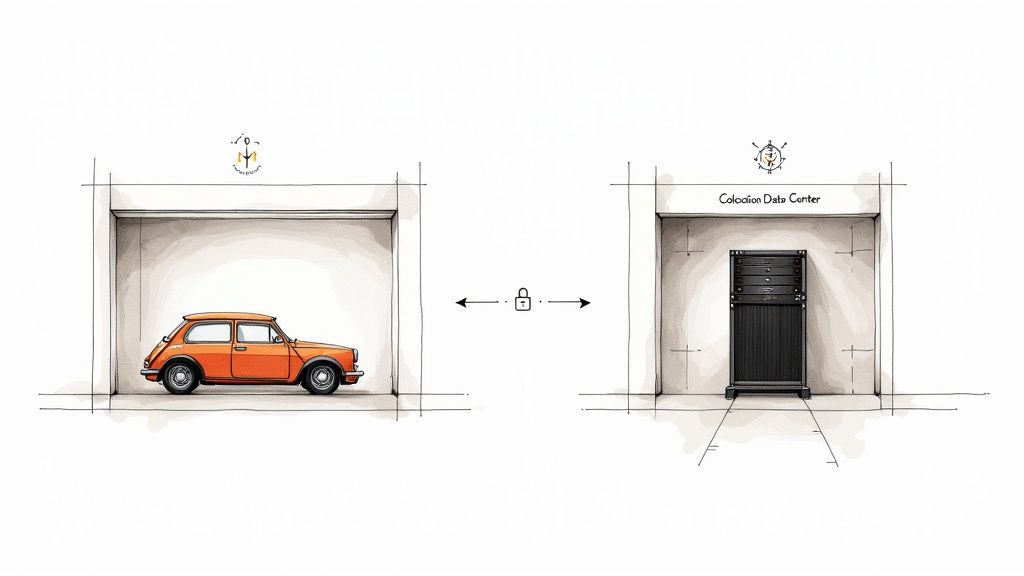
Let's use an analogy. Imagine you own a priceless art collection. Building a personal, museum-quality vault at your office with climate control, fire suppression, and Fort Knox-level security would be astronomically expensive and a logistical nightmare.
Instead, you could rent a secure, climate-controlled unit within a professional art storage facility. You own the art, you control access to it, but you're letting the experts handle the specialized environment and security.
That’s colocation in a nutshell. You provide your servers, storage, and networking gear (the "art collection"), and the colocation facility provides the enterprise-grade "vault." It’s a practical way to get top-tier infrastructure without having to build it from the ground up.
Who Handles What? The Partnership Breakdown
This setup creates a very clear division of labor. The colocation provider is obsessed with the physical facility—making sure the power never goes out, the cooling is always optimal, and the building is secure. This frees up your IT team to concentrate on what actually drives your business: managing your software, applications, and data.
This clear separation is one of the biggest draws. You’re essentially tapping into an infrastructure that would otherwise be out of reach for most businesses. Key features often include:
- Redundant Power Grids: Multiple power sources, battery backups (UPS), and massive on-site generators mean your equipment stays online, even during a city-wide outage.
- Industrial-Grade Cooling: Precision HVAC systems maintain the perfect temperature and humidity, preventing your expensive hardware from overheating and failing prematurely.
- Multi-Layered Physical Security: We're talking about perimeter fencing, secure "mantraps" at entry points, biometric scanners, and 24/7 video surveillance to protect your critical assets.
To make this crystal clear, here’s a simple breakdown of who manages what in a typical colocation partnership:
Who Manages What in a Colocation Partnership
| Component | Managed by the Colocation Provider | Managed by You (The Client) |
|---|---|---|
| Physical Building | ✅ Building maintenance, physical security, access control | ❌ |
| Power | ✅ Redundant utility feeds, UPS, backup generators | ❌ |
| Cooling | ✅ HVAC systems, temperature and humidity monitoring | ❌ |
| Network Connectivity | ✅ Carrier-neutral network access, physical cabling | ✅ Your own network configuration, firewalls |
| Servers & Storage | ❌ | ✅ Procuring, installing, and managing your hardware |
| Software & OS | ❌ | ✅ Installing and maintaining operating systems, applications |
| Data & Backups | ❌ | ✅ Managing your data, backup schedules, and recovery |
This table shows how you offload the heavy lifting of facility management while keeping total control over the technology that runs your business.
In essence, colocation lets you trade the unpredictable and enormous capital expenses (CapEx) of building your own data center for predictable, manageable operational expenses (OpEx).
This shift in spending gives you a ton of financial flexibility. As your business grows, you don't need to launch a major construction project to add more capacity. You just lease another rack or a larger cage. This kind of agility is a game-changer for companies needing to adapt quickly without being tied down by their physical footprint.
A Look Inside a Modern Colocation Facility
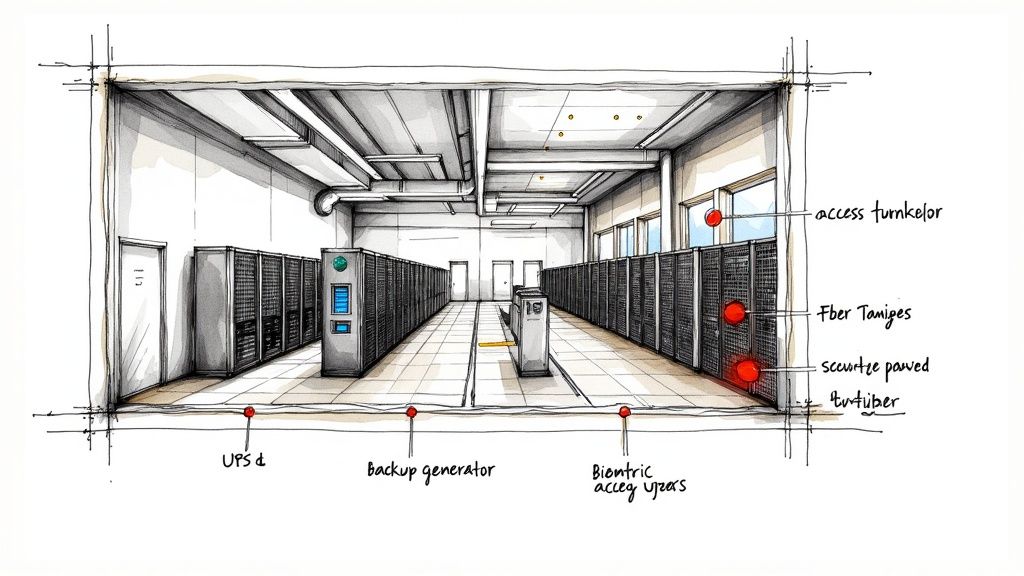
If you've never been inside a modern colocation data center, it’s hard to grasp the scale of the operation. Forget the image of a dusty server closet—this is the central nervous system of the internet. It's a highly controlled environment engineered from the ground up for one mission: to keep your IT infrastructure online, secure, and performing at its peak, no matter what.
So, what really makes these facilities tick? It all comes down to a few core pillars.
Unyielding Power and Precision Cooling
In a data center, even a millisecond of power loss can be catastrophic. That’s why everything is built on the principle of "N+1" redundancy, which simply means there’s at least one independent backup for every single critical system.
It starts with diverse power feeds, often from completely different utility substations. If one grid has an issue, the facility just switches to the other without a hitch. Behind that, massive banks of uninterruptible power supplies (UPS) act like giant, instant-on batteries, bridging any gap until the heavy hitters—the colossal diesel generators—kick in. These generators can power the entire building for days, sometimes weeks, making a city-wide blackout a complete non-issue for your operations.
Just as important as constant power is the climate. The servers and networking gear that run your business generate an incredible amount of heat. Left unchecked, that heat quickly leads to slowdowns and outright hardware failure.
A modern data center’s cooling system is an engineering marvel in its own right, often consuming 30-40% of the facility’s total power. The goal isn't just to make it cold, but to maintain precise temperature and humidity levels across the entire data hall.
To pull this off, they use sophisticated strategies and equipment:
- Hot Aisle/Cold Aisle Containment: This is a clever layout that separates cool air intake from hot air exhaust, which dramatically boosts cooling efficiency and prevents hot spots.
- Computer Room Air Handlers (CRAH): These powerful units continuously push cold air under raised floors and up through the server racks, whisking heat away.
- Liquid Cooling Solutions: For the most demanding hardware, like AI and machine learning clusters, some facilities are now using advanced liquid cooling to handle the extreme heat output.
Fortified Security and Unmatched Connectivity
The security at a top-tier colocation facility is no joke—think military-grade. Protecting your digital assets starts by physically protecting the servers they run on. Security is a layered affair, starting at the property line and getting progressively stricter as you move inward.
Getting to your specific server rack typically involves clearing multiple checkpoints:
- Perimeter Security: The property is usually surrounded by high fences, vehicle barriers, and is monitored 24/7 by video surveillance.
- Building Access: You can't just walk in the front door. Access requires authenticated credentials, and every entry is logged.
- Mantrap Doors: These are clever two-door vestibules that only allow one person through at a time after verifying their identity, making it impossible for someone to tailgate behind you.
- Biometric Scanners: The most secure areas, the actual data halls, are often protected by fingerprint or iris scanners.
- Cabinet and Cage Security: Finally, your own server rack or private cage is locked. You hold the key, giving you the final layer of control.
Beyond power and security, the biggest advantage is connectivity. A colocation facility is a major hub on the internet backbone. Most are carrier-neutral, which means dozens of different internet service providers (ISPs) and network carriers are physically present in the building.
This creates a competitive marketplace right at your fingertips. You can easily connect to multiple providers for redundancy, shop around for the best pricing, and get the lowest-latency connections for your applications. Knowing how to navigate this environment is key, and you can learn more about managing network resources in our guide to IPv4 leasing. This rich connectivity ecosystem is a fundamental reason why businesses choose colocation.
When you start looking past the racks of servers and the complex cooling systems, you realize that choosing a colocation data center isn't just a technical decision—it's a strategic one. For many businesses, it's a fundamental shift in how they handle their technology, unlocking some serious financial and operational advantages that are tough to get any other way.
This is the practical answer to that age-old IT problem: how do you get top-tier, enterprise-grade infrastructure without the colossal price tag and management headaches that usually come with it? The perks go far beyond just renting some space and power.
Shifting from Capital to Operational Expenses
Let’s talk money, because this is one of the biggest wins right out of the gate. Building your own private data center is a massive capital expenditure (CapEx). We're talking about enormous upfront costs for construction, redundant power grids, industrial-strength cooling, and physical security. It's an investment that can easily skyrocket into the millions.
Colocation completely flips that script. Instead of that huge initial hit, you're paying a predictable monthly fee for the space, power, and cooling you actually use. This moves your infrastructure spending from a daunting capital expense to a much more manageable operational expense (OpEx).
That financial shift from CapEx to OpEx is huge. It frees up precious capital that you can pump back into what actually grows your business—like product development, marketing, or hiring top talent—instead of sinking it into physical assets that just depreciate over time.
This model not only simplifies your financial forecasting but also lets you tie your IT costs directly to your operational needs. It gives you an agility that’s just not possible when you own the whole building.
Gaining Seamless Scalability and Agility
Your business isn't static, and your infrastructure shouldn't be either. A big product launch, a seasonal spike in demand, or just steady growth can suddenly require a lot more computing power. If you’re on-premise, scaling up is a slow, painful, and expensive process involving construction, power upgrades, and long hardware lead times.
Colocation gets rid of that friction completely. Need another server rack? You just lease more space. This on-demand scalability means your infrastructure can grow right alongside your business, making sure you have the resources you need, exactly when you need them. It's a huge reason the global colocation market is exploding, with projections showing it could nearly double from USD 104.2 billion in 2025 to USD 204.4 billion by 2030, largely fueled by the intense demands of AI and digital transformation. You can see the full market research about this growth on MarketsandMarkets.com.
And don't forget, this agility works both ways. If you need to scale down, you aren't left holding the bag on an oversized and underused facility that's draining your budget.
Achieving Enterprise-Grade Security and Compliance
For anyone in a regulated industry—think healthcare, finance, or e-commerce—compliance isn't optional. Trying to achieve certifications like HIPAA, SOC 2, or PCI DSS in your own data center is an incredibly complex, expensive, and ongoing battle.
This is where top-tier colocation providers really shine. They've already done all that heavy lifting for you. Their facilities are built from the ground up to meet these strict regulatory standards, and they go through regular, painstaking audits to keep their certifications current. When you place your servers in their facility, you inherit the benefits of their rock-solid physical and environmental controls.
This gives you a few key advantages:
- Reduced Audit Burden: You can leverage the provider's own compliance reports (like an Attestation of Compliance) to help satisfy your auditors, which dramatically simplifies your own audit process.
- Enhanced Security Posture: You instantly gain access to multi-layered physical security—from biometric scanners and mantraps to 24/7 on-site guards—that's far beyond what most companies could ever implement on their own.
- Peace of Mind: Knowing your physical infrastructure is locked down and compliant allows your team to focus on what they do best: securing your own applications and data.
Ensuring Superior Uptime and Reliability
Downtime kills revenue and torpedoes your reputation. A colocation facility's entire business model is staked on guaranteeing uptime. They invest immense resources into redundancy at every single level, from diverse power feeds and massive backup generators to multiple, independent network carriers.
This isn't just a promise; it's contractually guaranteed through a Service Level Agreement (SLA). A standard colocation SLA will promise 99.99% or even 99.999% uptime, and they put their money where their mouth is with financial penalties if they don't deliver. Reaching that level of reliability in-house would require a monumental investment. It provides the stable foundation every modern IT strategy needs, and it's a critical component for companies building out their hybrid cloud solutions.
Colocation vs Cloud vs On-Premise
Deciding where your IT infrastructure should live is one of the most important decisions you'll make for your business. This choice doesn't just affect your budget; it shapes your security, your compliance posture, and your ability to grow. To really get a handle on what a colocation data center offers, it helps to see how it stacks up against the other two big players: running everything yourself on-premise or going all-in with the public cloud.
Each path offers a unique mix of control, cost, and convenience. Let's dig into what that actually means for your day-to-day operations.
The On-Premise Data Center
Running your own data center is the old-school approach. Think of it like owning a custom-built house. You have complete and total control over every detail, from the brand of servers you install to the precise temperature of the server room. You build it, you run it, and you're the only one responsible for keeping it safe and operational.
But that level of control comes with a hefty price tag and a ton of headaches. You're on the hook for absolutely everything:
- Massive Upfront Costs: The initial capital needed for construction, redundant power, industrial-grade cooling, and physical security is staggering.
- Ongoing Maintenance: You need a skilled, in-house team managing the facility and the IT hardware, 24/7/365. That’s a major operational expense.
- Difficult Scalability: Need more capacity? That means a long, expensive construction project, not just a quick phone call.
For companies moving away from this model, retiring the old gear is a big job. This often requires professional data center decommissioning services to securely and responsibly dispose of outdated equipment.
The Public Cloud
The public cloud—platforms like AWS, Azure, or Google Cloud—is like renting a fully furnished apartment in a massive, modern high-rise. The flexibility and scalability are incredible. You can launch a new server in minutes and pay only for what you use, which is perfect for businesses with fluctuating or unpredictable needs.
Of course, that convenience has its trade-offs. You give up any direct control over the physical hardware your applications are running on. Costs can also become a runaway train if you're not carefully watching your usage, a common problem known as "cloud sprawl." While you gain amazing agility, you might run into trouble with specialized hardware needs or strict data residency rules.
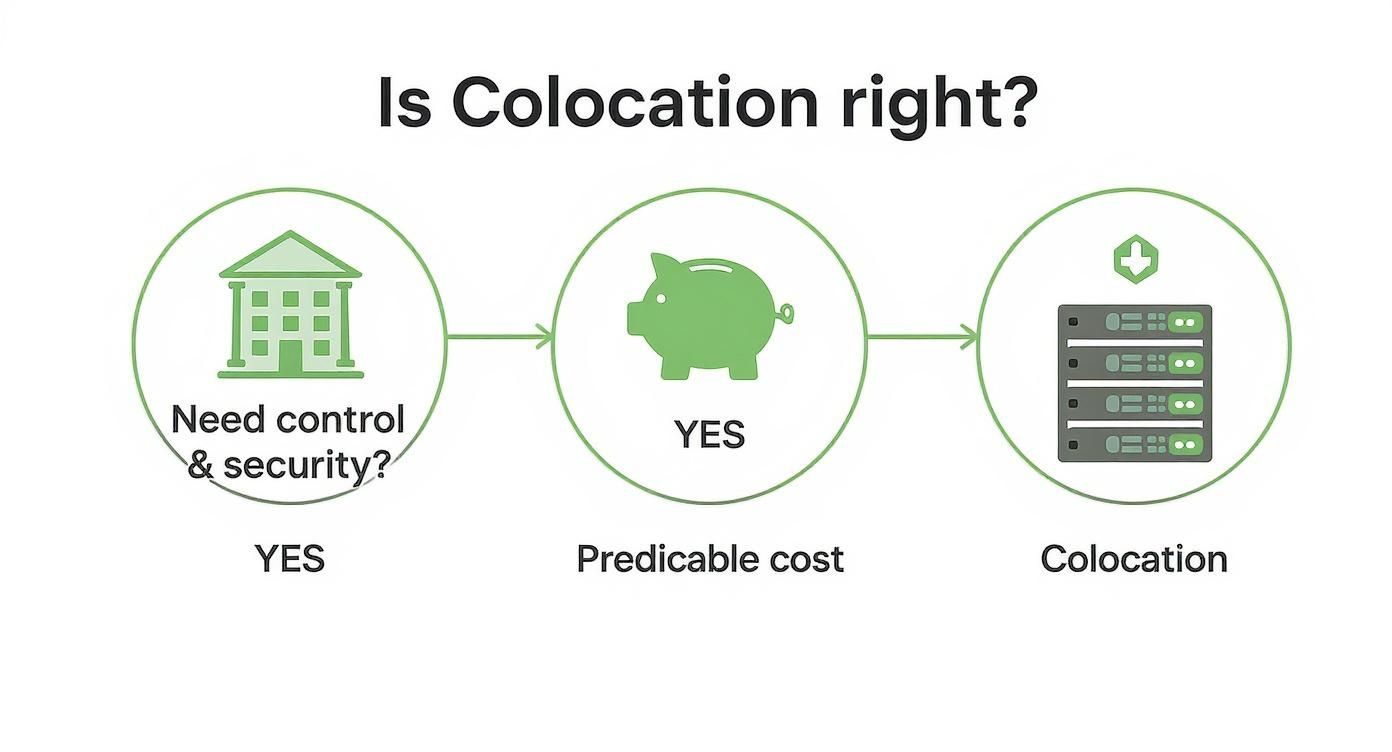
As this decision tree shows, once the need for hands-on hardware control and predictable spending comes into play, colocation starts to look like the most sensible path forward.
Colocation: The Strategic Middle Ground
So, where does colocation fit in? It’s the perfect hybrid, like owning a condo. You own your private, secure space—your server rack—but you share the building's maintenance, security, and premium amenities like power, cooling, and connectivity.
You get the control and security of owning your own hardware, just like an on-premise facility, but you tap into the operational efficiency and world-class infrastructure of a professional data center.
This balanced approach is precisely why the market is booming. The data center colocation industry in the U.S. is on pace to become a $17.1 billion market by 2025, driven by companies wanting to get out of the data center business themselves.
Colocation is the ideal fit for organizations that:
- Must adhere to strict compliance frameworks like HIPAA, PCI DSS, or SOC 2.
- Rely on legacy applications or specialized hardware that isn't a good fit for the cloud.
- Prefer predictable, monthly operational costs over huge, upfront capital investments.
- Need a stable and secure home base for a hybrid cloud strategy.
Comparing Your IT Infrastructure Options
To make the right call, you need to see how these three models compare on the criteria that matter most to your business. This table breaks down the key differences at a glance.
| Criteria | Colocation | Public Cloud | On-Premise |
|---|---|---|---|
| Control | High: Full control over your own hardware and software. | Low: Abstracted from physical hardware. Control at the OS/app level. | Total: Complete control over every aspect of hardware and facility. |
| Upfront Cost (CapEx) | Low-Medium: No facility costs; purchase your own servers. | Lowest: No hardware or facility costs; pay-as-you-go. | Highest: Significant investment in construction, power, and cooling. |
| Ongoing Cost (OpEx) | Predictable: Fixed monthly fee for space, power, cooling. | Variable: Pay-per-use model can fluctuate wildly. | High: Staffing, utilities, maintenance, and hardware refresh cycles. |
| Scalability | Medium: Can add racks/servers, but requires physical installation. | High: Scale resources up or down in minutes. | Low: Scaling is a slow, expensive construction project. |
| Security & Compliance | Shared Responsibility: Provider handles physical security and facility compliance; you handle your hardware and software. | Shared Responsibility: Provider secures the cloud; you secure what you put in it. | Full Responsibility: You are solely responsible for all physical and digital security. |
| Maintenance Burden | Low: Provider manages the facility infrastructure 24/7. | Lowest: Provider manages all underlying infrastructure. | Highest: You manage everything from the generator to the server OS. |
Ultimately, choosing colocation is a strategic move that lets you focus on your actual business, not on the complex and costly job of managing a data center. When paired with other solutions, it becomes a rock-solid foundation for a modern IT environment. You can see how this fits into a bigger picture in our overview of cloud hosting and managed services. This "best of both worlds" approach is why so many organizations find it’s the perfect fit for their needs.
How to Choose the Right Colocation Partner
https://www.youtube.com/embed/aQ8QE7gTt8g
Picking a colocation data center provider isn't like buying an off-the-shelf product. It's a long-term partnership that becomes the very foundation of your IT operations. The right provider does more than just rent you rack space; they become a critical extension of your team. That’s why the decision has to go much deeper than the monthly invoice.
If you think strategically from the start, you'll save yourself a world of headaches later. You need a partner who can support your business not just today, but for the next five or ten years as you grow.
Location and Latency Considerations
The physical location of the data center is one of the first things you need to nail down. Geography has a direct impact on latency—the time it takes for data to get from your servers to your users. For businesses with a strong regional customer base, like many here in the Phoenix area, choosing a local facility is key to delivering the fastest possible application response times.
But location isn't just about speed. It’s also a cornerstone of your disaster recovery plan. A common strategy is to have a primary colocation site close to your office for easy access, with a secondary site in a completely different geographic region. This setup ensures you stay online even if a local disaster strikes.
Scrutinizing SLAs and Compliance Certifications
Your Service Level Agreement (SLA) is the provider's contractual promise of uptime and performance. Don't just skim it—read every line. A solid provider will offer an SLA guaranteeing at least 99.99% uptime, but you have to understand the fine print.
What happens if they fail to meet that guarantee? Are there financial penalties? How do they define "downtime," and what's the exact process for reporting an outage? A strong SLA gives you both peace of mind and a clear path for recourse if things go wrong.
Just as important are the compliance certifications. If you're in a regulated industry, this is a deal-breaker. Ask for current audit reports for the standards that matter to your business:
- SOC 2 Type II: Verifies security, availability, and processing integrity.
- HIPAA: Essential for protecting sensitive patient health information.
- PCI DSS: Required for securing credit card and payment data.
Having these certifications in place proves the provider maintains the necessary controls, which makes your own compliance audits infinitely easier.
Evaluating Network and Support Services
One of the biggest advantages of a great colocation data center is its network ecosystem. A carrier-neutral facility is what you want. This means you have your choice of multiple network providers, which lets you build in redundancy and shop around for the best pricing. Having a diverse carrier mix is your best defense against a network outage.
Finally, take a hard look at the on-site support. "Remote hands" support is a lifesaver. This service lets the provider's on-site technicians act as your eyes and hands, handling tasks like rebooting a server, swapping a failed drive, or just checking a cable. It can save your team a trip to the facility for a five-minute fix.
The demand for high-quality colocation is intense right now. Vacancy rates in major North American markets are nearing 0%, and 73% of the new capacity being built is already pre-leased. According to research from JLL on these market dynamics, this tight market underscores just how critical it is to lock in a reliable partner with a clear roadmap for future capacity. Finding the right fit early is more important than ever.
Is Colocation the Right Move for Your Business?
So, after digging into what colocation is, how it works, and how it stacks up against other options, we get to the real question: is it the right choice for your business? It really boils down to one core idea—getting total, hands-on control of your own hardware without having to build and run a data center yourself.
Think of it as the perfect middle ground. You bring your own servers, storage, and networking gear, giving you complete say over your environment. Meanwhile, you're tapping into a facility that's already mastered the expensive and complex stuff like power, cooling, and security. This setup gives you a predictable bill and enterprise-level reliability without the headaches.
When Does Colocation Make the Most Sense?
Colocation isn't a one-size-fits-all solution, but it’s a game-changer in a few key situations. For any organization where control and security are non-negotiable, it's often the smartest play.
See if any of these sound familiar:
- You're in a Highly Regulated Industry: If you're in healthcare dealing with HIPAA, finance with PCI DSS, or the legal field, colocation is your friend. You can directly meet tough compliance rules by piggybacking on a provider's certified facility and audited security controls.
- You Have Legacy or Specialized Hardware: Let's be honest, not everything is built for the cloud. Colocation provides a safe, high-performance home for those critical legacy systems or specialized pieces of equipment that just can't be virtualized.
- You're Building a Hybrid Cloud: Colocation is the perfect private anchor for a hybrid strategy. You can keep your sensitive databases and core apps on your own gear while still connecting to public clouds for extra computing power when you need it.
Far from being old-school, colocation is a surprisingly modern and essential part of a smart infrastructure plan. It gives you a stable, secure, and financially predictable foundation to build on.
At the end of the day, opting for a colocation data center is a strategic decision to put your team's energy where it counts: on the applications and data that run your business. When you let experts handle the facility management, your IT crew is freed up to innovate and drive real value. It’s about moving forward with confidence, knowing your infrastructure is in good hands and ready to handle whatever comes next.
Common Questions About Colocation
Thinking about moving your IT gear into a data center? It’s a big decision, and you probably have a few questions about how it all works on a practical level. Let's break down some of the most common ones.
Getting these details straight is key to figuring out if colocation is the right fit and what to expect from a provider.
What Is the Difference Between Wholesale and Retail Colocation
The biggest difference between retail and wholesale colocation is simply the amount of space and power you need. Think of it like real estate.
Most businesses go with retail colocation. This is where you lease a smaller, defined space—maybe a single server rack or a private, locked cage inside a larger, shared room. It’s flexible and scales well for most companies.
Wholesale colocation is for the big players who need massive capacity. We're talking about a large company leasing an entire private suite or even a whole data hall, complete with its own dedicated power and cooling systems. So, if retail is like leasing an office, wholesale is like leasing the entire building.
Can I Access My Servers Whenever I Need To
Absolutely. Any reputable colocation facility will give you secure, 24/7/365 physical access to your equipment. You can't just walk in, of course. You'll need to go through their security process, which typically involves multiple checkpoints, biometric scans, and being on a pre-approved access list.
But once you're cleared, you can get your hands on your hardware any time, day or night. This is essential for handling maintenance, upgrades, or unexpected emergencies yourself.
That guaranteed access is a fundamental promise of colocation. You always maintain complete physical control over your servers, even though they're located in a highly secure, professionally managed facility. For businesses facing strict compliance rules, this level of control isn't just a benefit—it's a requirement.
What Are Remote Hands Services
"Remote hands" are a game-changer. This is a support service where the data center's own expert technicians act as your hands on-site, performing physical tasks on your gear whenever you ask. It saves you the massive headache and cost of dispatching your own engineers for small but crucial jobs.
Some common tasks you can ask remote hands to do include:
- Rebooting a frozen server.
- Plugging in or reseating a finicky network cable.
- Swapping a dead hard drive or bad stick of RAM.
- Simply walking over to your rack to visually check the status lights on a piece of equipment.
How Does Colocation Fit into a Hybrid Cloud Strategy
Colocation is often the bedrock of a smart hybrid cloud strategy. It gives you the perfect "home base" for the systems you need to keep on private hardware—think sensitive customer data, high-performance databases, or legacy applications that aren't built for the cloud.
From your secure rack in the colocation facility, you can set up direct, high-speed, and secure connections to public cloud platforms like AWS, Azure, or Google Cloud. This setup really delivers the best of both worlds. You get the ironclad security and control of your own hardware for core systems, plus the flexibility and endless scale of the public cloud for everything else.
At Armour Cloud, we specialize in providing managed colocation services from our Phoenix-area data centers, designed for businesses that demand security, compliance, and reliability. Learn how we can build the perfect foundation for your IT infrastructure.
Article created using Outrank