what is colocation data center: a quick, clear guide
Ever wonder what happens when your server closet just can't keep up anymore? Or when the cost and hassle of managing your own data center infrastructure start to outweigh the benefits?
That's where colocation comes in. Think of it as moving your company's servers out of that cramped, overheated room and into a high-tech fortress built specifically for performance and security. You're not building your own facility from the ground up; instead, you rent a secure, dedicated space in a specialized data center. This gives you access to their top-tier power, cooling, connectivity, and physical security while you keep complete control over your own hardware.
Your Server Room Just Got a Major Upgrade
A great way to picture a colocation data center is like a luxury apartment building for your servers. You own the "furniture"—your servers, storage, and networking gear—but the building owner provides all the essential utilities, round-the-clock security, and expert maintenance.
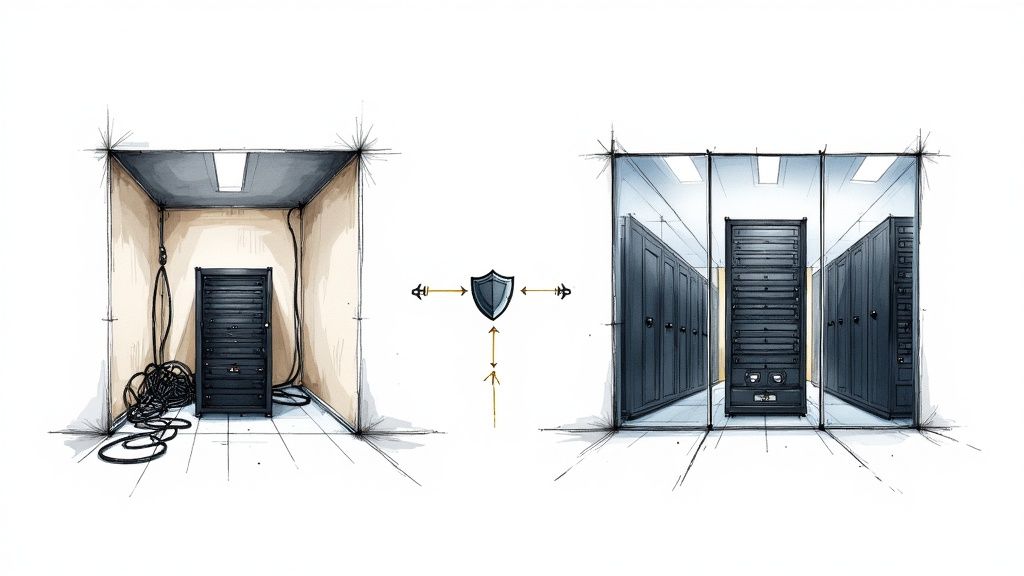
This setup lets your business tap into a facility that would cost tens of millions of dollars to build yourself. What would have been a massive capital expense becomes a predictable, manageable operational cost.
You're not just renting a rack; you're plugging into an entire ecosystem designed for uptime and reliability. This partnership, known as the shared responsibility model, is really the secret sauce of colocation. It allows your team to focus on what they do best—managing your software, applications, and data—while the provider handles the incredibly complex and expensive job of running a world-class data center.
The Shared Responsibility Model
Getting a handle on who does what is absolutely key to a successful colocation strategy. It's a true partnership where each side has a clear set of duties. This lets you confidently offload the heavy lifting of managing physical infrastructure.
It's this clear division of labor that makes colocation such a smart strategic move. You no longer have to lose sleep over power outages, cooling system failures, or a physical security breach that could bring an in-house server room to its knees.
By moving to a colocation facility, businesses can achieve an average of 40-60% savings compared to the total cost of ownership for an on-premise data center. This shifts IT spending from capital-intensive projects to predictable operational budgets.
What You Manage vs. What the Provider Manages
At its core, the colocation relationship is defined by a very clear split in responsibilities. This ensures you keep control right where it matters most—over your own equipment and software—while the provider delivers the stable, resilient environment your hardware needs to run perfectly.
To make this crystal clear, let's break down who is responsible for what.
Colocation Responsibility Breakdown: You vs. The Provider
This table illustrates the standard division of duties in a colocation setup. You handle your tech stack, and the provider ensures the environment it lives in is secure, powered, and cooled 24/7.
| Component/Service | Managed By You (The Client) | Managed By The Colocation Provider |
|---|---|---|
| Servers & Storage | You purchase, configure, and maintain all your server and storage hardware. | Provides the secure cabinet or cage space for your equipment. |
| Software & OS | You install, update, and manage the operating systems and applications. | Does not interact with your software stack. |
| Network Gear | You install and configure your switches, routers, and firewalls. | Provides network connectivity options (carrier neutrality). |
| Power Infrastructure | You plug your equipment into the provided power distribution units (PDUs). | Guarantees redundant power, UPS backup, and generator availability. |
| Environmental Control | Not your responsibility. | Manages all HVAC and precision cooling to maintain optimal temperatures. |
| Physical Security | You manage access permissions for your specific employees. | Manages facility-wide security, including biometrics, guards, and surveillance. |
| Remote Support | You can perform remote work or request "remote hands" support for physical tasks. | Offers "remote hands" services for tasks like reboots or cable swaps. |
Understanding this strategic handover is central to seeing what a colocation data center truly offers your business: peace of mind and the freedom to focus on growth.
A Look Inside a Colocation Fortress
Walk into a colocation data center, and you'll immediately realize it’s a world apart from your typical office server closet. These places are engineered from the ground up to be fortresses for your most critical IT hardware, guaranteeing security, performance, and near-perfect uptime. It’s not just about renting space; it's about providing the ideal, stable environment for your servers to thrive.
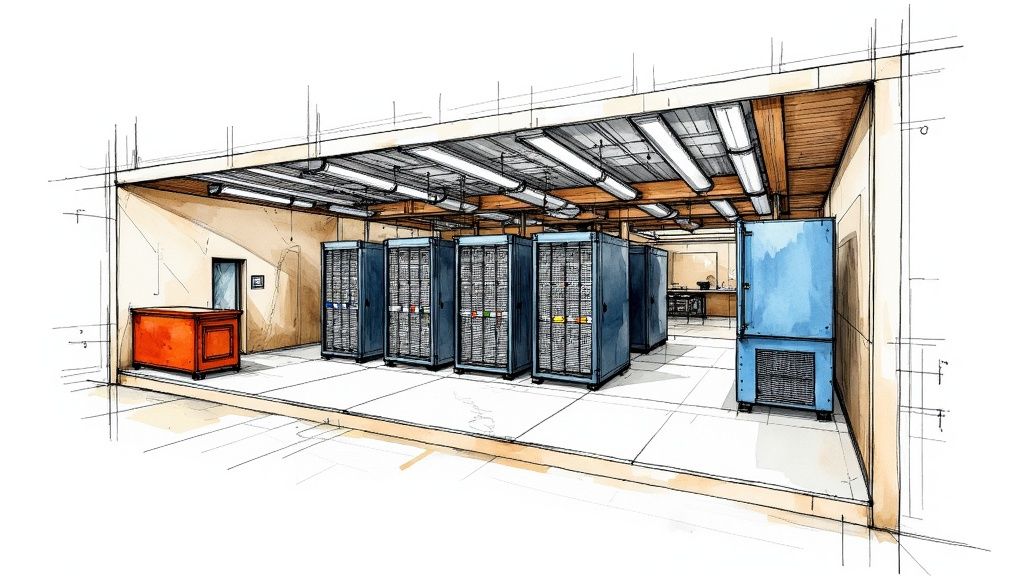
The difference becomes clear when you look at the four pillars every top-tier facility is built on: power, cooling, security, and connectivity. Each one is designed with layers upon layers of redundancy, so a single failure point simply can't take your business offline. Let’s break down what makes this infrastructure so incredibly resilient.
Uninterrupted Power and Precision Cooling
In a data center, power is everything, and it's handled with military-grade precision. Most facilities are connected to at least two independent utility power grids. If one goes down, the system instantly fails over to the other without your servers ever noticing.
But what happens if both grids fail? That’s where the real backup systems kick in:
- Uninterruptible Power Supply (UPS): Think of this as a giant battery bank. The moment it detects a power flicker, it takes over instantly, feeding clean, stable electricity to the racks while the heavy-duty generators spin up.
- Industrial Diesel Generators: These aren't your backyard portables. These are massive generators capable of powering the entire building for days or even weeks, ensuring a prolonged regional blackout is a non-issue.
Just as important is cooling. High-end servers generate a staggering amount of heat, which is the mortal enemy of electronics. Colocation centers use advanced Computer Room Air Conditioning (CRAC) and Computer Room Air Handler (CRAH) units that maintain the perfect temperature and humidity. Many use sophisticated hot-aisle/cold-aisle designs to channel cool air exactly where it's needed and efficiently pull hot exhaust away.
A colocation data center is an environment of managed extremes. Power is redundant, cooling is precise, and security is absolute, creating a stable foundation that a typical business could never affordably replicate on its own.
Multi-Layered Physical Security
Protecting your data starts with protecting the physical servers it lives on. Colocation facilities use a "defense-in-depth" strategy, with multiple security layers you have to pass through to get anywhere near the equipment.
Imagine a modern-day castle. First, you have a perimeter fence, monitored by 24/7 on-site security staff and blanketed with video surveillance. To even get in the front door, you need to pass through secure checkpoints requiring multi-factor authentication, like a keycard paired with a biometric fingerprint or iris scan.
Once you’re inside, you’ll encounter mantraps—a set of interlocking doors where the second door won’t open until the first one has closed securely behind you. This prevents tailgating. Finally, your servers are locked away in their own private steel cage or cabinet, giving you that final, crucial layer of physical control.
A Hub of Boundless Connectivity
One of the biggest, and often overlooked, benefits of colocation is carrier neutrality. This means the data center isn't locked into a single internet provider. Instead, it’s a major crossroads where dozens of local, national, and global network carriers converge.
This gives you total freedom. You can choose the provider that offers the best performance and price for your needs. Better yet, you can connect to multiple carriers at once for ultimate redundancy, ensuring you always have a path to the internet. It also allows you to set up direct, blazing-fast private connections to major cloud providers like AWS and Azure.
To truly appreciate the technical sophistication, you have to look under the hood. For instance, understanding the robust electrical infrastructure, including three-phase power systems, is essential to grasp how these facilities power dense racks of equipment so reliably. It's no wonder the industry is booming; the data center colocation market in the U.S. is projected to hit $17.1 billion by 2025 as businesses demand more scalable and resilient infrastructure.
Why Colocation Makes Good Business Sense
It’s one thing to understand the nuts and bolts of a colocation data center, but it’s another to see how those technical features actually benefit your business. For many companies, the leap from a server closet down the hall to a professional colocation facility isn't just a technical upgrade—it's a major strategic move. It unlocks financial flexibility, shores up security, and gives you a new level of operational agility.
The biggest immediate change is how you handle your IT budget. Gone are the days of massive, infrequent capital expenditures (CapEx) to build or refresh an in-house data center. Instead, you shift to a predictable, monthly operational expense (OpEx). This frees up a significant amount of cash that can be put back into what your business does best, whether that's product development, marketing, or hiring your next star employee.
The market reflects this value. The global colocation data center market is projected to skyrocket from USD 104.2 billion in 2025 to USD 204.4 billion by 2030, largely fueled by digital transformation and the massive computing needs of AI. This isn't just a trend; it's a fundamental shift in how businesses approach their infrastructure.
Strengthen Your Security and Compliance Foundation
If you're in a regulated industry like healthcare, finance, or e-commerce, you know that staying compliant isn't optional—it's a constant, resource-draining effort. This is where a colocation partner can be a game-changer. You're essentially tapping into their already-established, audited compliance framework.
Top-tier facilities don't just say they're secure; they prove it with rigorous, ongoing third-party audits. These certifications become a cornerstone of your own compliance strategy.
- SOC 2: This audit confirms the provider has a rock-solid system for managing data to protect your company's interests and your clients' privacy.
- HIPAA: For anyone handling patient data, this shows the physical and administrative safeguards are in place to protect electronic Protected Health Information (ePHI).
- PCI DSS: If you process credit cards, this certification ensures the physical environment meets the strict standards required to protect cardholder data.
When you place your servers in a facility that already meets these standards, you inherit a powerful security posture right out of the gate. Your own audits become simpler, your compliance risks shrink, and your team can stop worrying about the physical plant and focus on securing your actual applications.
Get Unbeatable Uptime and Reliability
Downtime isn't just an annoyance; it's a direct hit to your bottom line and your brand's reputation. A single hour offline can cost a small business thousands of dollars and a large enterprise millions. Colocation facilities are built from the ground up to prevent this, with layers of redundancy in every critical system from power to cooling.
Your guarantee of uptime comes in the form of a Service Level Agreement (SLA). A good provider will offer a legally binding agreement promising 99.999% availability, giving you peace of mind that infrastructure failures won't bring your business to a halt.
Trying to achieve this level of reliability in-house would require a monumental investment that's simply out of reach for most companies. It’s also why colocation is a cornerstone of so many business continuity and disaster recovery plans. For a great guide on building out your own strategy, check out this Disaster Recovery Planning Checklist.
Scale Your Infrastructure on Your Terms
Business needs are never static. One quarter you might need to spin up a dozen servers for a new product launch, and the next you might need to scale back after a seasonal rush. Colocation gives you the physical space, power, and cooling to grow without the headaches and high costs of building out your own facility.
This agility means you can react to market opportunities almost instantly. Need another rack? Or maybe a private, secured cage? You can get that set up in a fraction of the time it would take to call the contractors.
And for businesses that want even more of a hands-off experience, some providers offer a hosted managed private cloud service. This gives you the control and security of your own hardware combined with the convenience of a fully managed service, making sure your infrastructure can always keep up with your ambition.
Choosing Your IT Infrastructure Path
Knowing what a colocation data center is gets you halfway there. The next step is figuring out where it fits into the bigger picture of your IT strategy. Today, businesses have three main roads they can take when it comes to housing their critical hardware and applications. Each path has its own unique mix of benefits, costs, and best-case scenarios.
There’s no one-size-fits-all answer here. The right choice hinges entirely on your company's goals, budget, and day-to-day operational needs. Do you need total, hands-on control over your servers? Or is the ability to scale up or down at a moment's notice more important?
Ultimately, the decision boils down to finding the right balance between control, cost, scalability, and security. Let's dig into how colocation stacks up against the two main alternatives: the public cloud and a traditional on-premise data center.
Comparing Your Three Core Options
Think of these infrastructure models like different types of vehicles. You wouldn't use a sports car to haul furniture, and you wouldn't enter a moving truck in a street race. Each one is built for a specific purpose. Choosing your IT infrastructure requires that same kind of strategic thinking.
This simple decision tree can help you visualize which path might be a good starting point for your business.
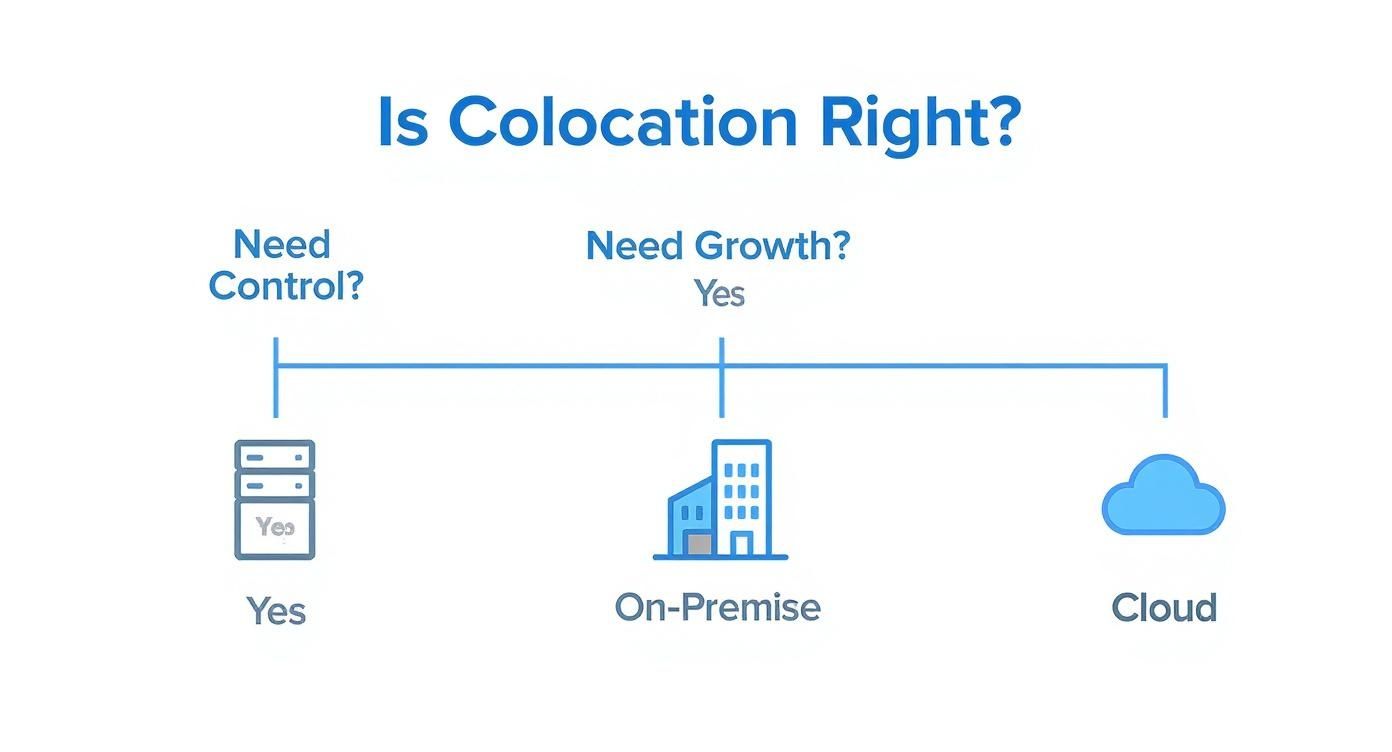
As you can see, the need for control is a major fork in the road. Colocation is the perfect solution for businesses that need to own their hardware but also want the flexibility to grow without building a whole new facility.
To help you weigh your options, let's compare these models across the factors that matter most.
IT Infrastructure Models Compared Colocation vs Cloud vs On-Premise
The table below offers a head-to-head comparison, breaking down how each model performs across key business and technical criteria. It's a quick way to see the fundamental trade-offs you'll be making with each choice.
| Factor | Colocation | Public Cloud | On-Premise |
|---|---|---|---|
| Initial Cost | Low to Moderate (OpEx) | Very Low (OpEx) | Very High (CapEx) |
| Control | High (You own the hardware) | Low (Provider owns all hardware) | Absolute (You own everything) |
| Scalability | Good (Add servers/racks) | Excellent (Instant, elastic) | Poor (Requires construction) |
| Security | Shared (Physical by provider) | Shared (Platform by provider) | Your sole responsibility |
| Predictability | High (Fixed monthly costs) | Low (Usage-based billing) | High (But with large CapEx) |
| Compliance | Strong (Inherit provider certs) | Strong (Provider has certs) | Your sole responsibility |
Each model clearly has its strengths. An on-premise data center gives you ultimate control but at a massive upfront cost, while the public cloud delivers incredible flexibility but can lead to unpredictable monthly bills and less direct control over the underlying hardware.
Finding the Right Fit for Your Workloads
The public cloud is a rockstar for workloads with unpredictable traffic. Its elastic, pay-as-you-go model is perfect for web apps, development environments, and big data analytics where you need to spin resources up and down quickly.
An on-premise data center is the go-to for organizations with very specific hardware needs, unusual security protocols, or legacy systems that just can't be moved. But that total control comes at a steep price in both capital and operational headaches.
Colocation provides a strategic middle ground. It blends the control of an on-premise solution with the financial efficiency and enterprise-grade resilience of the cloud, making it the perfect fit for stable, mission-critical applications that require high performance and predictable costs.
By choosing colocation, you keep full ownership and control of your servers while handing off the enormous burden of managing the physical data center environment. It’s this balanced approach that makes it the foundation of a smart IT strategy for so many businesses.
Even better, many providers—including Armour Cloud—offer cloud hosting and managed services to create a hybrid environment alongside your colocation setup. This lets you put each workload in its ideal home, optimizing for cost, performance, and security across the board.
Finding the Right Colocation Partner
Choosing a colocation provider isn't just about renting rack space; it's about finding a long-term partner to safeguard your most critical digital assets. It’s a strategic decision that moves beyond the what and into the how—requiring a hard look at whether a provider can meet your needs today and support your ambitions for tomorrow.
The right partner is really an extension of your own IT team. They provide the rock-solid foundation that frees you up to focus on innovation. That means you have to look past the price tag and dig into the non-negotiables: compliance, connectivity, and their unwavering commitment to uptime.
Verifying Compliance and Certifications
For any business—and especially those in heavily regulated fields like healthcare or finance—compliance is the first hurdle. A trustworthy colocation data center doesn’t just say they’re secure; they prove it with stacks of reports from continuous, independent audits.
Before you even think about signing a contract, you need to verify their certifications. These aren't just fancy logos for a website. They represent a deep-seated commitment to operational excellence and airtight security.
- SOC 2 (Service Organization Control 2): Think of this as the gold standard. A SOC 2 report validates that the provider has strict controls in place to protect the security, availability, and confidentiality of your data. It’s a baseline requirement for any provider you’re seriously considering.
- HIPAA (Health Insurance Portability and Accountability Act): This is non-negotiable for anyone in healthcare. The provider has to show they have the physical, technical, and administrative safeguards required to protect patient health information.
- PCI DSS (Payment Card Industry Data Security Standard): If you process, store, or transmit credit card data, the facility must meet these demanding physical security standards. This helps you maintain your own compliance and avoid costly penalties.
Having these certifications in place dramatically reduces your own audit burden. You get to inherit a strong, pre-vetted security posture right from the start.
Assessing Technical and Operational Capabilities
Once you’ve checked the compliance boxes, it’s time to look under the hood. A provider's technical infrastructure is what determines whether they can truly support your operations as you scale. Power and cooling are the absolute lifeblood of any data center. You should be asking potential partners about their power density capabilities—measured in kilowatts (kW) per rack—to make sure they can handle your power-hungry gear both now and in the future.
Just as critical is their Service Level Agreement (SLA). This is the provider's contractual promise to you about uptime. Don't settle for anything less than 99.99% availability, and be sure to read the fine print about remedies or credits if they ever fail to meet that guarantee.
A provider’s willingness to offer a robust, financially-backed SLA is a direct reflection of their confidence in their own infrastructure. It separates the premier facilities from the rest of the pack.
Finally, take a close look at their connectivity options. A carrier-neutral facility is a game-changer. It gives you the freedom to bring in multiple network providers, which creates competition that drives down your costs. More importantly, it allows you to build in redundancy, eliminating a single point of failure for your internet access. Many businesses use these diverse connections to build powerful hybrid cloud solutions with direct, low-latency links to major cloud platforms.
Planning for Future Growth and Support
As data center demand skyrockets, just finding available space is becoming a real challenge. North America currently leads the global market with a 41% share, but that popularity has driven vacancy rates to all-time lows. This makes finding a partner who can actually accommodate your future expansion more important than ever. If you're interested in the market trends, you can explore detailed research on the data center market to see just how tight things are.
This squeeze is exactly why emerging markets like Phoenix, with its favorable business conditions, are becoming so attractive. But don't forget the human element. Remote hands support—having access to on-site technicians—is an incredibly valuable service. It can save you from an expensive, last-minute trip to the facility just to reboot a server or swap a cable. Choosing the right partner means finding one that invests in the trifecta of success: the infrastructure, the people, and the processes to help you grow.
Common Questions About Colocation Data Centers
When you start looking into what a colocation data center can do for your business, a lot of practical questions pop up. It's one thing to understand the concept, but another to see how it applies in the real world. Let's tackle some of the most common questions about service models, migration, and how this strategy fits into the modern IT puzzle.
What’s the Difference Between Retail and Wholesale Colocation?
The first thing to get a handle on is the two main flavors of colocation: retail and wholesale. A good way to think about it is like leasing office space. You can rent a single office, or you can lease an entire floor. Each one makes sense for a different size and type of need.
Retail colocation is what most businesses use. It’s perfect for small to medium-sized companies and plenty of larger enterprises, too. With retail, you rent smaller, specific spaces—think individual server cabinets or a private, locked cage. The contracts are usually more flexible, and the provider often bundles things like power and network connectivity into the price. It's the go-to choice for companies that need a serious, enterprise-grade environment without needing a football field's worth of space.
On the other hand, wholesale colocation is built for massive deployments. We’re talking about the scale needed by hyperscale cloud providers, huge financial institutions, and content delivery networks. Instead of renting a cabinet, a wholesale client leases a large private data hall or a dedicated suite. These are long-term leases where the client usually manages their own power and cooling inside their space. It offers incredible control and scale, but the cost and commitment are way beyond what most businesses need.
Can I Get Help Moving My Servers into the Data Center?
Absolutely. The thought of physically moving all your servers can be daunting, but any good colocation provider has this figured out. The solution is a service called "remote hands" or "smart hands." This is an incredibly valuable offering where the data center’s on-site expert technicians basically become a trusted extension of your own IT team.
Instead of your people spending time and money traveling to the facility, you can lean on these pros for all sorts of tasks.
- Receiving Shipments: They can accept deliveries of your new servers and equipment and keep it all secure until you’re ready for the install.
- Racking and Stacking: Technicians will physically install your servers, switches, and other hardware into the racks, following your exact layout.
- Cabling and Connectivity: They handle all the physical cabling, connecting your gear to power and network ports with clean, professional cable management.
- Basic Troubleshooting: If a server goes offline, they can do simple things like a physical reboot or check the diagnostic lights, saving you a trip.
This kind of support changes the game. It turns colocation from just renting space into a real partnership, letting your team manage everything efficiently from wherever they are.
How Does Colocation Support a Hybrid Cloud Strategy?
Many people think colocation is an alternative to the cloud, but it's actually one of the best ways to build a powerful hybrid cloud strategy. A modern, carrier-neutral colocation facility is the perfect central hub, giving you a secure, high-performance meeting point for your private gear and your public cloud services. It's where the magic of interconnection happens.
These facilities offer direct, private, low-latency connections to the big cloud players like AWS, Microsoft Azure, and Google Cloud. This lets you build a seamless architecture that gives you the best of both worlds.
A colocation data center is the physical foundation for a hybrid cloud. It gives you a private, controlled environment for your most sensitive workloads while providing a high-speed on-ramp to the public cloud's limitless scalability.
For instance, you could keep your core database with sensitive customer data on your own hardware in the colocation facility—giving you maximum security and control. At the same time, you can connect it directly to a scalable, customer-facing web app running in a public cloud. That setup delivers amazing performance without ever exposing your most critical data to the public internet.
Is Colocation Secure Enough for Regulated Industries?
Yes, and honestly, a top-tier colocation data center is almost always more secure and compliant than what a business could build or maintain on its own. If you’re in healthcare, finance, or e-commerce, the built-in compliance framework of a colocation provider is one of its biggest selling points.
Good facilities don't just say they're secure—they prove it with constant, tough third-party audits. These audits lead to critical certifications that you can "inherit" to make your own compliance journey much easier.
- SOC 2: This report validates that the provider has strict internal controls for protecting customer data, ensuring security, availability, and confidentiality.
- ISO 27001: An international standard for information security management. It shows they have a systematic, documented approach to protecting sensitive company and customer information.
- HIPAA: A must for healthcare organizations. This confirms the provider has the right physical, administrative, and technical safeguards in place to protect electronic Protected Health Information (ePHI).
- PCI DSS: Essential for any company that handles cardholder data. It attests that the facility meets the strict physical security rules needed to protect financial information.
By choosing a provider that holds these certifications, you dramatically shrink your own audit scope and compliance headaches. You're building your IT infrastructure on a foundation that’s already been vetted against the highest industry standards, which gives you, your customers, and your auditors a whole lot more confidence.
At Armour Cloud, we understand the unique challenges faced by regulated industries and Phoenix-area businesses. Our managed colocation services provide the secure, compliant, and reliable foundation you need to protect your data and grow your operations with confidence. Discover how our local expertise and robust infrastructure can become your strategic advantage.
Article created using Outrank