Managed IT Services Phoenix for Business Growth
Think of your company's technology like a high-performance car. You could try to be the mechanic, the driver, and the navigator all at once, or you could hire a professional pit crew to keep it running at peak condition so you can focus on winning the race. That's what a managed IT services Phoenix provider does for your business—they're your expert tech team, managing everything behind the scenes.
Why Phoenix Businesses Are Choosing Managed IT

As Phoenix grows into a major economic powerhouse, local businesses are leaving the old "break-fix" IT model in the dust. That approach—where you wait for something to break and then scramble for an expensive emergency fix—just doesn't cut it anymore. In today's world, that kind of reactive thinking leads to crippling downtime and opens the door to serious security threats.
The smart move now is toward a proactive partnership. Companies are teaming up with Managed Services Providers (MSPs) to turn their IT from a constant headache into a genuine competitive advantage.
The Shift From Reactive Fixes to Proactive Strategy
What’s driving this change? It really boils down to getting specialized expertise that’s incredibly difficult and costly to build internally. A good MSP gives you a whole team of seasoned pros for one predictable monthly fee, which is a massive financial and operational win compared to hiring a full-time IT staff.
This table gives a quick breakdown of the core differences:
Comparing In-House IT vs Managed IT Services
| Aspect | In-House IT | Managed IT Services |
|---|---|---|
| Cost Structure | High fixed costs (salaries, benefits, training) plus unpredictable capital expenses. | A predictable, flat monthly operational expense. |
| Expertise | Limited to the knowledge of a few individuals. | Access to a deep bench of specialists in security, cloud, networking, and more. |
| Operational Focus | Often reactive, juggling daily fires and user issues. | Proactive monitoring and strategic planning to prevent problems before they start. |
| Availability | Typically limited to standard business hours (9-to-5). | 24/7/365 monitoring, support, and emergency response. |
| Technology Access | Budget constraints can limit access to enterprise-grade tools. | Leverages best-in-class security and management tools across all clients. |
As you can see, the value proposition goes far beyond just fixing computers. For businesses in a competitive market like Phoenix, the key motivators for making the switch are crystal clear:
- Cybersecurity Defense: You get advanced security tools and round-the-clock monitoring to defend against an ever-growing list of digital threats.
- Predictable Budgeting: Say goodbye to shocking repair bills. A fixed monthly fee covers everything from maintenance and monitoring to helpdesk support.
- Focus on Core Business: Your team is freed up to concentrate on what they do best—serving customers and growing the company—instead of wrestling with tech problems.
When you outsource your IT management, you're essentially getting a virtual Chief Information Officer (vCIO). This person provides high-level strategic guidance on technology investments, compliance, and how to build an infrastructure that supports your future goals. That kind of oversight is invaluable.
A Growing Market Reflecting a National Trend
The surge in demand for managed IT in Phoenix is part of a much larger national trend. Businesses everywhere are realizing they need expert partners to navigate their digital transformation.
As of 2024, the U.S. managed services market was already valued at around USD 79.17 billion. But get this—it's projected to more than double, hitting USD 183.47 billion by 2030. That's a compound annual growth rate of roughly 14.1%, which is a clear signal of how businesses are fundamentally changing the way they operate.
To see the bigger picture and why this shift is happening so quickly, it’s worth checking out these 5 Reasons Why Cloud Managed IT Is The Wave Of The Future. Ultimately, partnering with a provider of managed IT services in Phoenix is no longer just a way to save a few dollars; it's a strategic business decision for achieving rock-solid security, efficiency, and a real edge over the competition.
The Core Services That Power Your Business
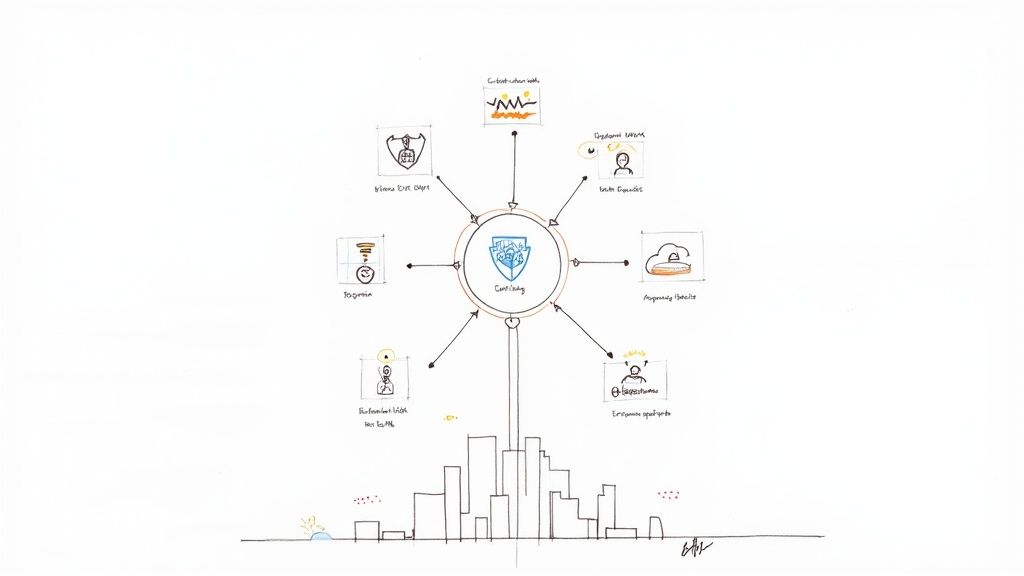
So, what does a provider of managed IT services in Phoenix actually do for you day-to-day? Forget the high-level talk for a second. Think of it as a toolbox filled with specialized instruments, each designed to handle a critical part of your company's tech. The best part? One expert team manages the entire toolkit.
These core services are the engine that keeps your business running—smoothly, securely, and without you having to worry about it. They turn abstract tech tasks into real, tangible value, protecting your assets and letting your team focus on what they do best.
Proactive 24/7 Network Monitoring
Imagine a security guard who not only watches for intruders but also spots a tiny crack in the foundation before it can threaten the whole building. That’s exactly what proactive monitoring does for your network. Your MSP uses sophisticated tools to keep an eye on your systems 24/7/365, catching the earliest warning signs of trouble.
This constant vigilance means potential problems—like a server hitting its storage limit or suspicious network activity—are found and fixed long before they cause a company-wide outage.
For a Phoenix logistics company, this is the difference between a small server tweak at 2 AM and a complete shutdown of shipping and receiving during peak hours. It’s all about preventing problems, not just cleaning up the mess after they’ve already cost you money.
Advanced Cybersecurity: Your Digital Bodyguard
In this day and age, solid cybersecurity isn't optional. A good MSP acts as your digital bodyguard, putting multiple layers of defense in place to protect your sensitive data from a constantly growing list of threats.
This goes way beyond simply installing antivirus software. It’s about building a comprehensive security posture that includes:
- Firewall Management: Setting up and maintaining a strong perimeter to block unwanted access.
- Threat Detection: Using advanced tools to spot and neutralize malware, phishing scams, and ransomware before they cause chaos.
- Security Patching: Making sure all your software and systems are consistently updated to close known security gaps.
- Employee Training: Teaching your team how to recognize and avoid common cyber threats.
For a Scottsdale financial advisory firm, this kind of security is fundamental. It's how they maintain client trust and stay compliant with industry regulations. Protecting confidential financial data from a breach isn't just good practice—it safeguards their reputation and their bottom line.
Responsive Helpdesk and User Support
When someone on your team hits a tech snag, productivity grinds to a halt. A central part of any managed services agreement is a responsive, knowledgeable helpdesk your employees can count on.
Whether it’s a forgotten password, a quirky software glitch, or a connection issue, your team has a direct line to experts who can get them back on track quickly. This immediate support cuts down on frustration and wasted time, letting your staff get back to their real jobs. It’s one of the most visible—and valuable—parts of managed IT. To get a better feel for how all the pieces fit together, you can explore a full breakdown of comprehensive managed IT services.
Strategic IT Consulting and Virtual CIO
Great IT management isn't just about fixing today’s problems; it’s about planning for tomorrow. Your MSP can provide what’s called a Virtual Chief Information Officer (vCIO), offering the kind of high-level guidance that aligns your technology with your actual business goals.
Your vCIO is there to help with:
- Technology Roadmapping: Planning for future IT investments and upgrades that will support your growth.
- Budgeting: Creating a predictable, stable IT budget without any nasty surprise costs.
- Vendor Management: Handling the back-and-forth with your internet, software, and hardware providers so you don’t have to.
This strategic partnership ensures you’re not just spending money on tech, but investing it wisely. Beyond the basics, this can also include expert advice on key business tools, like streamlining workflows through accounting software integration. This big-picture approach is what turns IT from a necessary expense into a genuine driver of business success.
Navigating IT Compliance in Phoenix Industries
For any Phoenix business in healthcare, finance, or law, compliance isn't just another item on a to-do list—it's the very bedrock of your operation. You're handling incredibly sensitive data every single day. One slip-up can lead to crippling fines, a shattered reputation, and a complete erosion of client trust. This is precisely why choosing the right provider of managed IT services in Phoenix is one of the most important strategic moves you can make.
A great MSP does more than just keep your tech running. They become a true partner in compliance. They know the labyrinth of rules governing your industry and build an IT environment that’s designed from the ground up to meet those exact, non-negotiable standards. It’s all about creating a secure, documented, and defensible framework that protects your clients and your business.
This intense need for specialized IT support is why the managed services market is booming. Globally, it's expected to hit USD 572.15 billion by 2033, jumping from about USD 279.16 billion in 2024. This growth is particularly explosive in compliance-heavy fields like healthcare and finance—two major pillars of the Phoenix economy. Digging into the market growth data reveals just how powerful this trend is.
Securing Patient Data in Healthcare
From private clinics in Scottsdale to the Valley's larger hospital networks, the Health Insurance Portability and Accountability Act (HIPAA) is the law of the land. Protecting electronic Protected Health Information (ePHI) isn't optional; it's a legal and ethical mandate. This is where an MSP with a deep understanding of healthcare compliance becomes invaluable.
They put a multi-layered security strategy in place that goes way beyond basic IT help. This includes things like:
- Access Controls: Making absolutely sure only authorized staff can see or change patient records.
- Data Encryption: Scrambling ePHI so it's unreadable, whether it's sitting on a server or moving across the network.
- Audit Trails: Keeping detailed logs of who accessed what data and when—something that's critical for accountability and investigating any incidents.
By taking charge of these technical safeguards, an MSP frees up healthcare providers to do what they do best: care for patients. They can work confidently, knowing their IT infrastructure is built to support their compliance obligations. For a deeper look into this specific area, our guide on HIPAA compliant cloud hosting and managed services offers more detailed insights.
Meeting Strict Rules in Finance and Law
Phoenix's financial and legal sectors have their own tight sets of regulations. Financial firms have to follow rules from bodies like the Financial Industry Regulatory Authority (FINRA) and the Securities and Exchange Commission (SEC), which have strict requirements for storing, protecting, and archiving client financial data. A compliance-savvy MSP knows how to implement the necessary controls to meet these demands.
For law firms, the main game is protecting client confidentiality and attorney-client privilege. An MSP helps lock down communication channels, enforces strong data management policies, and ensures digital files are shielded from breaches or prying eyes. This is fundamental to protecting sensitive case information and upholding the firm’s integrity.
In both fields, the goal is identical: protect highly sensitive information to build unbreakable trust. A specialized MSP delivers the technical foundation and strategic guidance needed to manage these risks, letting firms focus on serving their clients instead of wrestling with technology. They turn IT from a potential liability into a core strength of a compliant and trustworthy business.
Exploring Advanced Cloud and Infrastructure Solutions
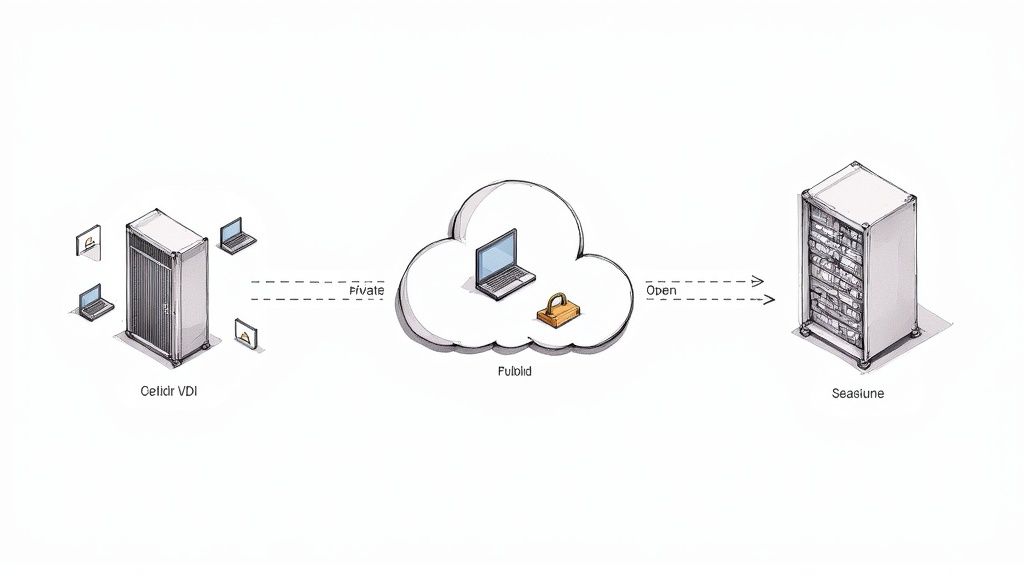
As your business scales, your tech needs get more complicated. Basic IT support is the foundation, but real growth often hinges on more sophisticated infrastructure—the kind that boosts security, flexibility, and day-to-day efficiency. The best providers of managed IT services in Phoenix don't just fix problems; they offer a suite of these powerful tools, putting enterprise-grade technology within reach for businesses of any size.
These aren't just solutions for massive corporations. They're practical answers to the real challenges modern companies face, from securely managing a remote workforce to protecting sensitive client data. Let's dig into some of the most impactful options available today.
Unlocking Secure Remote Work with VDI
Imagine giving every single employee—whether they're in your Phoenix office, working from home in Mesa, or on the road—a perfect, secure clone of their company desktop. But instead of running on their personal laptop, this desktop runs on your company's powerful, centralized servers. That's the magic of Virtual Desktop Infrastructure (VDI).
Instead of scattering applications and sensitive files across dozens of individual computers, VDI pulls everything into one secure data center. Employees log into their virtual desktop over the internet, but the actual data never leaves your protected environment.
This approach is a game-changer for Phoenix businesses, especially in highly regulated fields like finance, law, or healthcare. Here's why:
- Enhanced Security: Since data isn't physically stored on laptops or tablets, the risk of a breach from a lost or stolen device is virtually eliminated.
- Simplified Management: Your IT team can update, patch, and manage hundreds of desktops from a single dashboard. This ensures every employee is working with the same secure, up-to-date software.
- Improved Accessibility: Your team gets a consistent, high-performance desktop experience from any location with an internet connection, making it perfect for today's remote and hybrid work models.
VDI completely changes your security posture by keeping your company's most valuable asset—its data—safely inside your protected infrastructure. It’s like having a secure digital office that your employees can access from anywhere without ever taking critical files home with them.
Finding the Right Fit: Private vs. Hybrid Cloud
The word "cloud" is thrown around a lot, but not all clouds are created equal. Figuring out the difference between private and hybrid models is the key to building the right strategy for your business, and a good managed IT services partner in Phoenix will walk you through this decision.
A private cloud is exactly what it sounds like: infrastructure that is 100% dedicated to your organization. It delivers the highest level of security and control, which makes it the go-to choice for businesses with strict compliance needs, like those handling patient health information or sensitive financial data.
A hybrid cloud, on the other hand, combines a private cloud with one or more public cloud services (like Microsoft Azure or Amazon Web Services). This model gives you the best of both worlds. For a closer look at this flexible approach, check out our in-depth guide to hybrid cloud solutions.
This table breaks down some common use cases:
| Cloud Model | Best For… | Example Phoenix Scenario |
|---|---|---|
| Private Cloud | Businesses with strict security and compliance needs (HIPAA, FINRA) that require complete control over their data environment. | A healthcare clinic storing patient records and medical imaging, ensuring maximum data isolation and control. |
| Hybrid Cloud | Companies that need the security of a private cloud for sensitive data but want the flexibility and scalability of the public cloud for other tasks. | A local software development company hosting its sensitive source code on a private cloud while using the public cloud for scalable app testing. |
The Smart Alternative: Managed Colocation
What if you want the rock-solid security and reliability of a top-tier data center but don't have the budget to build and maintain one yourself? That's exactly where managed colocation comes in.
Think of it like renting a highly secure, climate-controlled apartment for your servers in an enterprise-grade facility. You own your hardware, but you house it somewhere with redundant power, advanced cooling, and layers of physical security that would be nearly impossible for a small or mid-sized business to replicate.
This isn't a niche market; managed data center services accounted for a massive USD 48.2 billion in 2022 and are projected to nearly triple by 2032. It’s a proven strategy for gaining enterprise-level infrastructure without the enterprise-level price tag.
How to Choose the Right Phoenix IT Partner
Picking a managed IT services provider in Phoenix isn't just about handing over your tech problems. It's about bringing a long-term partner into your business. Get it right, and you’ll see faster growth and ironclad operations. Get it wrong, and you're in for a world of downtime, security headaches, and constant frustration.
Think of it like hiring a new executive for your team. You wouldn't bring on a CFO without digging into their background and track record, right? You need to apply that same level of scrutiny here. Your mission is to find a team that has the technical chops and genuinely understands the unique pulse of the Phoenix business community.
Key Questions to Ask Potential Providers
Before you even think about signing a contract, you need to come armed with the right questions. These aren't just for show; they're designed to peel back the sales pitch and reveal how a provider truly operates. A transparent, confident partner will welcome these questions and give you straight answers.
Here’s a checklist of what you need to cover during your interviews:
- Local Experience: "Can you share a few success stories or references from other Phoenix businesses in our field, like healthcare or finance?"
- Team Expertise: "What kinds of certifications do your technicians hold—things like CompTIA, Microsoft, or Cisco? How do you keep their skills sharp?"
- Security Protocols: "Walk me through your security strategy. How do you actually handle threat detection, what’s your game plan for an incident, and do you help train our employees to be more secure?"
- Proactive Management: "What tools are you using for 24/7 network monitoring? Can you tell me about a time you caught a major problem before it could impact a client?"
- Onboarding Process: "What does your onboarding and migration process look like from start to finish? How do you make sure our business doesn't grind to a halt during the switch?"
Pay close attention to their answers. If you get vague responses or they seem hesitant to share details, consider that a major red flag. It speaks volumes about their operational maturity and how much they actually care about their clients' success.
Understanding the Service Level Agreement
The Service Level Agreement (SLA) is, without a doubt, the most important document you will sign. This is the legally binding contract that spells out exactly what services you'll get, how performance will be measured, and what the provider is on the hook for. Don't just skim it—read every single line.
An SLA isn't just a formality; it’s the official rulebook for your partnership. It sets crystal-clear expectations and holds everyone accountable, making sure you get the exact level of service your business needs to succeed. A solid SLA is the bedrock of a great long-term relationship.
To really get what you're signing, you need to understand the numbers behind the promises. These metrics aren't just industry jargon; they have a direct, real-world impact on your team's productivity and your company's bottom line.
Key SLA Metrics to Evaluate in an IT Provider Contract
The table below breaks down the most critical metrics you’ll find in an SLA. Understanding these benchmarks will help you cut through the noise and compare managed IT services providers in Phoenix, so you can lock in a partner who offers real value and reliability.
| SLA Metric | What It Measures | Industry Benchmark |
|---|---|---|
| Response Time | How quickly the provider acknowledges your support request after you submit it. This is the first step in the support process. | For critical issues, this should be 15 minutes or less. For less urgent matters, 1-2 hours is acceptable. |
| Resolution Time | The total time it takes to completely fix the reported issue from the moment you submit the ticket. | This varies by issue severity but should be clearly defined. A good benchmark is 4 hours for critical issues. |
| Uptime Guarantee | The percentage of time your systems and network are guaranteed to be operational and available. | The industry standard is 99.9% or higher. Anything less should be questioned, as even a small dip means significant downtime over a year. |
| First-Contact Resolution | The percentage of support issues that are fully resolved during the very first interaction with the helpdesk. | A high rate (around 70-75%) indicates an experienced and efficient support team that doesn't pass tickets around. |
Ultimately, these metrics are your shield. They ensure the provider lives up to their promises and gives you a clear path for recourse if they don't. A strong SLA is a sign of a professional partner who is ready to stand by their work.
Your Guide to a Smooth Onboarding Process
The idea of switching your IT provider can feel overwhelming, like a massive project just waiting to cause disruption. But with a professional partner, the entire process can be surprisingly painless. A well-built onboarding plan is what separates a successful transition from a frustrating one, giving you a clear, predictable roadmap instead of anxiety.
This isn't just about flipping a switch and crossing your fingers. It’s a carefully managed project broken down into distinct stages, each one designed to get ahead of problems before they can start. Any quality provider of managed IT services in Phoenix will walk you through every step with total transparency.
The Four Stages of a Seamless Transition
The migration is usually handled in four phases. Each stage builds on the one before it, making sure every detail is covered from the initial groundwork to long-term support. This structured approach is what guarantees a stable and secure cutover.
-
Discovery and Assessment: This is the most critical first step. Your new IT partner needs to do a deep audit of your current setup—everything from servers and network hardware to software licenses and security protocols. This isn’t a quick glance; it’s a non-negotiable phase to map out every dependency and potential roadblock.
-
Strategic Planning: Once they have a complete picture of your environment, the provider will build a detailed migration plan. This blueprint includes setting timelines, assigning responsibilities, and, most importantly, creating a rollback plan. Think of a rollback plan as your safety net—it outlines the exact steps to instantly revert to your old system if any serious issues pop up.
-
Implementation and Testing: Now the technical work begins. This is almost always done during off-hours to minimize any impact on your team. Before making the final switch, your provider will run rigorous tests in a staged environment to confirm everything works perfectly, from application access to email flow.
-
Go-Live and Ongoing Support: After a successful test run, the official cutover happens. Your new provider should have technicians on-site or on standby to tackle any immediate user questions or minor adjustments. This ensures your team feels supported from the very first minute.
The infographic below really captures the right mindset for this journey—one focused on careful assessment, asking the right questions, and constant review.
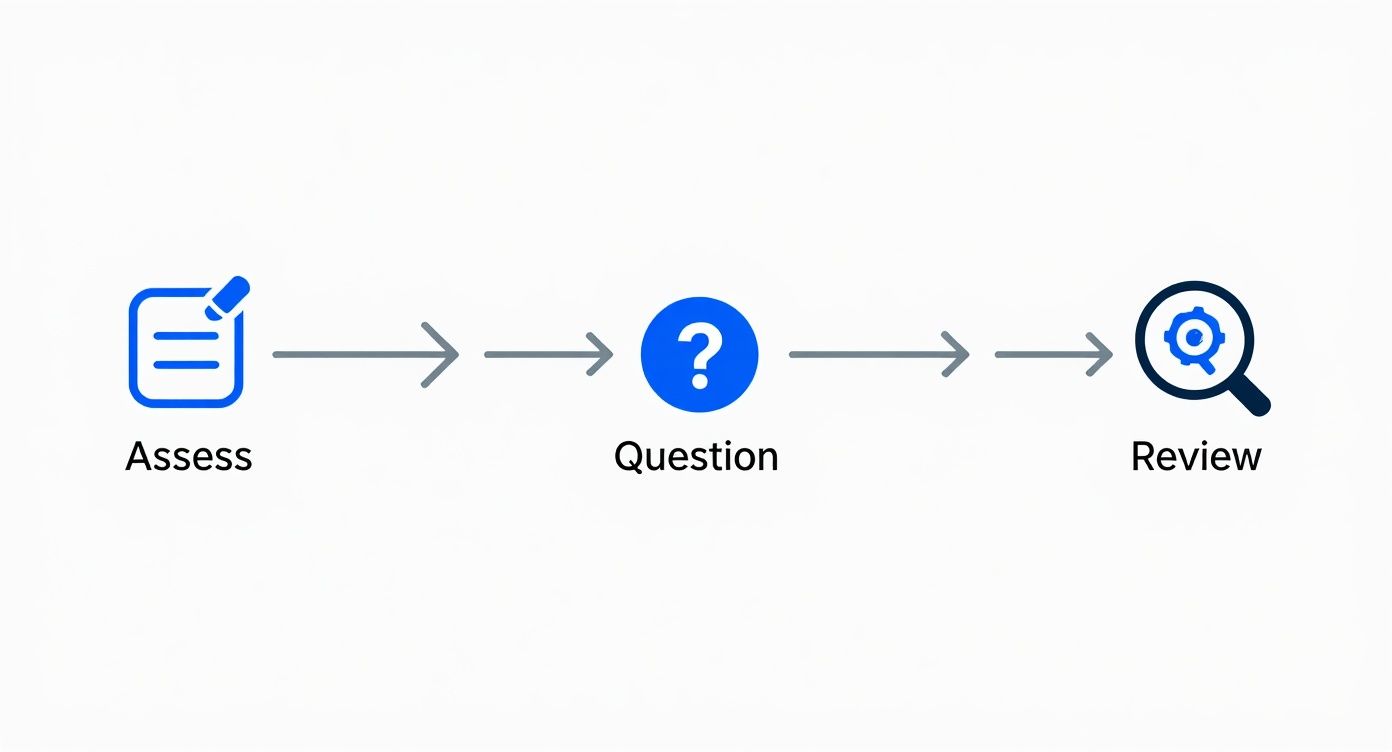
This visual really hammers home the point that a great partnership starts with a thorough, inquisitive approach to understanding your unique business needs.
A common mistake is rushing the discovery phase. A provider who wants to skip this deep dive is waving a major red flag. A thorough initial audit is the single most important factor in preventing surprise downtime and scope creep later on.
By sticking to this proven process, the migration becomes a controlled and predictable event. It takes the guesswork out of the equation and ensures that your move to a new provider of managed IT services in Phoenix isn't a source of stress, but a confident step toward better security, stability, and support.
Your Questions About Phoenix IT Services, Answered
Making a big change in your business always brings up questions. It’s smart to be thorough. Here are some straightforward answers to the questions we hear most often from Phoenix business owners who are thinking about managed IT.
What's the Real Cost of IT Services in Phoenix?
There’s no simple, one-size-fits-all price tag for managed IT services in Phoenix. The cost really hinges on your specific needs—how many people are on your team, how complex your current setup is, and what level of service you need. Are you just looking for basic support, or do you need heavy-duty cybersecurity and compliance oversight?
Most IT partners use a per-user, per-month model, which makes budgeting a lot easier. For a typical small business, you can expect to see pricing in the range of $100 to $250 per user each month. This turns what used to be unpredictable, lump-sum capital expenses into a steady, manageable operating cost that covers everything from monitoring and helpdesk to security.
When Something Breaks, How Fast is the Response?
This is one of the most critical questions, and the answer should be spelled out clearly in your Service Level Agreement (SLA). When a true emergency hits—think a server going down or a major security incident—a quality provider will guarantee a response in 15 minutes or less, 24/7/365.
It's not just about getting an automated ticket response. A solid SLA means a real expert is jumping on the problem and actively working on a fix right away. That immediate action is what prevents a minor hiccup from turning into a costly, business-stopping disaster.
How Does a Managed Service Provider Actually Make Us More Secure?
A good MSP builds a security strategy with multiple layers, creating a defense that’s far more robust than what most small businesses could build on their own. It’s so much more than just putting antivirus software on your computers.
Think of it as a complete security program that includes:
- Proactive Threat Hunting: Using sophisticated tools to find and stop threats before they can cause damage.
- Patch Management: Diligently keeping all your software updated to plug security holes as soon as they’re discovered.
- Employee Training: Turning your team into a human firewall by teaching them how to spot and avoid phishing scams and other tricks.
How Long Does it Take to Switch IT Providers?
A smooth, well-managed transition usually takes between 30 and 90 days. The timeline really depends on the size of your company and the complexity of your technology. A professional provider won't just flip a switch; they follow a careful process.
This involves a deep dive into your current systems, careful planning, and a lot of testing to make sure everything works perfectly. Most of this work is scheduled after hours or over a weekend, so your day-to-day business isn't disrupted at all.
Ready to secure your business with a trusted local partner? Armour Cloud delivers expert managed IT services, secure cloud solutions, and compliance support designed for Phoenix businesses. Let us handle the technology so you can focus on growth. Learn more at https://armourcloud.io.
Article created using Outrank