
Managed IT Services for Accounting Firms Guide
When we talk about managed IT services for accounting firms, we're not talking about your standard, run-of-the-mill tech support. This is a specialized, proactive approach to technology management built from the ground up to handle the unique security, compliance, and workflow challenges that CPAs face every single day.
It’s about moving beyond just fixing what's broken and forming a strategic partnership. This partnership is designed to protect highly sensitive client data, guarantee your systems are running smoothly during the chaos of tax season, and optimize the very software you depend on to get the job done.
Why Modern Accounting Firms Need Specialized IT

For CPAs, the days of treating IT as just another utility bill are long gone. Today, technology is the core engine of an accounting practice. It directly impacts client trust, day-to-day efficiency, regulatory compliance, and your firm’s ability to grow.
The old "break-fix" model—where you only call for help when a server crashes or a laptop dies—simply doesn't cut it anymore. It's a purely reactive approach in a world that demands a proactive defense and a clear vision for the future.
Modern accounting firms are under incredible pressure. You aren't just crunching numbers; you are the guardians of your clients' most sensitive financial and personal information. This makes your firm a prime target for cybercriminals who understand the immense value of the data you hold. At the same time, the regulatory landscape is getting tougher, with rules like the FTC Safeguards Rule requiring serious data protection protocols.
The Shift from General Support to Strategic Partnership
The move toward specialized managed IT services isn't just a trend; it's a reflection of a massive shift in the accounting industry itself. Firms are leaving behind dusty on-premise servers and clunky desktop software for more agile, secure cloud-based platforms. This digital evolution demands an IT partner who truly gets the nuances of accounting applications, data security, and compliance.
The numbers don't lie. The global cloud accounting market exploded from $2.62 billion in 2020 to an estimated $4.25 billion by the end of 2023. This incredible growth shows just how many firms are moving to the cloud, a complex transition that's best handled by an expert IT provider.
A specialized IT partner is more than a help desk; they're a strategic part of your team. Their focus is on:
- Proactive Security: Building a multi-layered defense to stop cyberattacks before they ever happen.
- Operational Efficiency: Making sure your core tools, from tax software to practice management systems, run flawlessly without frustrating interruptions.
- Compliance Alignment: Designing and maintaining an IT environment that meets and exceeds regulatory standards, making audits smoother and reducing risk.
- Strategic Growth: Creating a scalable technology foundation that can support your firm as you bring on new clients, hire more staff, and expand your services.
When you hand off the complexities of IT management, you and your partners can finally stop troubleshooting tech problems and get back to what you do best: providing high-value advisory services that build strong client relationships and drive profitability.
To stay ahead, many firms are turning to things like accounting process automation to streamline repetitive tasks and boost accuracy. A knowledgeable IT partner is crucial for implementing and securing these kinds of advanced workflows. At the end of the day, investing in managed IT services is an investment in your firm's resilience, security, and future.
Core IT Services Built for Accounting Firms
When an accounting firm invests in technology, it's not just about buying new computers or software. It’s about building the very foundation of client trust, operational efficiency, and your own peace of mind when it comes to regulations. Your average IT support company might be great at keeping PCs running, but they likely don’t get the specific pressures of tax season, the quirks of your accounting software, or the strict compliance rules you live by.
This is where specialized managed IT services come in, designed from the ground up for the unique challenges of an accounting practice. This isn't just a trend; it's a fundamental shift. Over the last decade, we've seen accounting firms steadily increase their technology spend from 3.89% to 5.25% of total revenue. That's not just spending for spending's sake—it's a smart investment in sophisticated cloud platforms and outsourced IT management that directly solve industry-specific problems.
Secure Virtual Desktops: A Digital Fortress for Client Data
Imagine your entire office—every desktop, file, and critical application like QuickBooks or Lacerte—existing inside a private, highly secure digital bubble. That, in a nutshell, is a Secure Virtual Desktop Infrastructure (VDI). Instead of sensitive client data being scattered across dozens of individual laptops and home computers, it all lives in one central, protected data center.
Your team gets the exact same desktop experience they’re used to, whether they're in the office, at home, or on-site with a client. The crucial difference? The data itself never leaves the fortified server. This is an absolute game-changer for security and remote work. If a laptop gets lost or stolen, you don't panic. No client data was ever on it to begin with.
This approach gives you some major advantages:
- Centralized Security: All your firm's data lives in one place, making it exponentially easier to protect, monitor, and back up.
- Uniform Application Access: No more version-control headaches. Everyone on the team is always using the same, up-to-date software.
- Simplified Compliance: Proving you have total control over client data becomes straightforward when it’s not spread across countless personal devices.
Proactive Data Protection and Disaster Recovery
For any accounting firm, data isn't just important—it's everything. The thought of losing client files, tax returns, or financial statements to a server crash, ransomware attack, or even a simple fire is terrifying. A specialized IT partner goes way beyond basic backups to build a complete data protection and disaster recovery (DR) strategy.
This is much more than just copying files to an external drive once a week. It means creating automated, frequent backups of your entire system, encrypted and stored in multiple secure locations. Even more importantly, it means having a clear, tested plan to get your firm back up and running fast if the worst happens.
Think of it this way: A simple backup is like having a spare tire in your trunk. A full disaster recovery plan is like having a dedicated roadside assistance crew on speed dial, ready to get you back on the road in minutes, not days.
Advanced Email Security and M365 Management
Email is still the number one way cybercriminals try to break into accounting firms. Phishing scams designed to steal login credentials or launch ransomware are getting scarily sophisticated, and your standard spam filter just can't keep up anymore.
Managed IT services for accountants deploy advanced email security that uses AI to spot and block these modern threats. This isn't your old-school filter; it includes things like:
- Impersonation Protection: Detects and flags emails pretending to be from a firm partner or a major client asking for a wire transfer.
- Malicious Link Scanning: Checks where a link actually goes in real-time before you can even click on it.
- Attachment Sandboxing: Opens attachments in a safe, isolated virtual space first to see if they contain any hidden malware.
Beyond just security, properly managing your Microsoft 365 environment is key. A dedicated provider makes sure your team can collaborate securely using Teams, SharePoint, and OneDrive, all while enforcing the right security policies. For firms wanting to get the most out of their Microsoft investment, exploring Microsoft 365 managed services can be a huge step up in both efficiency and security.
Migration Planning and Compliance Mapping
Thinking about moving your systems to the cloud? The idea of downtime during that process is enough to give any partner nightmares. A core service from a specialized provider is painstaking migration planning. They map out and handle the entire project—from the initial assessment to the final cutover—ensuring a smooth transition that barely impacts your billable hours.
Better yet, an IT partner who knows the accounting industry helps map your technology directly to compliance rules like the FTC Safeguards Rule or SOC 2. They don't just give you the tools; they provide the documentation and proof you need to show auditors that your firm is serious about protecting data. It simplifies audits and significantly reduces your firm's liability.
The difference between generic and specialized IT support becomes crystal clear when you compare them side-by-side.
Essential IT Services for Accounting Firms vs Standard IT Support
| Feature/Service | Standard IT Support | Managed IT Services for Accounting Firms |
|---|---|---|
| Security Approach | Basic antivirus, firewall, and spam filtering. | Advanced threat protection, email security with impersonation detection, and proactive vulnerability scanning. |
| Software Expertise | General knowledge of common business software (e.g., Office). | Deep expertise in QuickBooks, Lacerte, CCH Axcess, and other industry-specific accounting applications. |
| Compliance Understanding | Limited awareness of industry-specific regulations. | Maps IT controls directly to FTC Safeguards Rule, SOC 2, and other relevant compliance frameworks. |
| Support Availability | Typically standard 9-to-5 business hours. | 24/7/365 support with an understanding of tax season urgency and critical deadlines. |
| Data Backup | Simple file-level backups, often stored locally. | Comprehensive disaster recovery (DR) plans with off-site and cloud replication for rapid restoration. |
| User Onboarding | Sets up a new user with basic network access. | Manages secure access to all specific applications, VDI environments, and enforces firm-wide policies. |
Ultimately, a standard provider keeps the lights on. A specialized partner acts as a strategic asset, helping protect your firm, improve your efficiency, and secure your clients' trust.
Navigating Cyber Threats and Compliance Rules
As an accounting or tax professional, you are the trusted guardian of your clients' most sensitive financial information. You hold the keys to their financial kingdom, and unfortunately, that puts a giant target on your back. To a hacker, your network isn't just a server—it's a treasure chest, making your firm a prime target for constant cyberattacks.
The threats aren't random. They're often sophisticated and designed to exploit the very way you work. Imagine ransomware locking up every single client file a week before the tax deadline. Or a cleverly worded email, seemingly from a senior partner, tricking a junior accountant into wiring funds to a fraudulent account. A single misstep can lead to catastrophic financial losses, a shattered reputation, and serious legal trouble.
Building a Multi-Layered Defense Strategy
In this environment, basic antivirus and a simple firewall just don't cut it anymore. Real security is about building layers of defense, like the concentric walls of a fortress. If one layer is breached, another is waiting to stop the threat. This is where managed IT services for accounting firms become a game-changer.
An expert IT partner doesn't just put out fires; they proactively build a security architecture specifically for your industry's needs. This isn't generic IT support. It’s a specialized defense that includes:
- Advanced Threat Detection: Using smart systems that watch your network 24/7 for any suspicious behavior that might signal an attack is underway.
- Proactive Vulnerability Management: Constantly scanning your systems for security gaps and patching them before criminals have a chance to get in.
- Robust Email Security: Implementing advanced filters that go far beyond catching spam. They’re designed to spot and block phishing attempts, malicious attachments, and impersonation scams. A huge part of this is making sure your client communications are secure; you can learn more about deploying powerful email encryption to protect those critical conversations.
- Employee Security Training: Turning your team into your first line of defense by teaching them how to recognize and report suspicious activity.
This concept map shows how these specialized IT services create a cohesive shield around your firm's core operations.
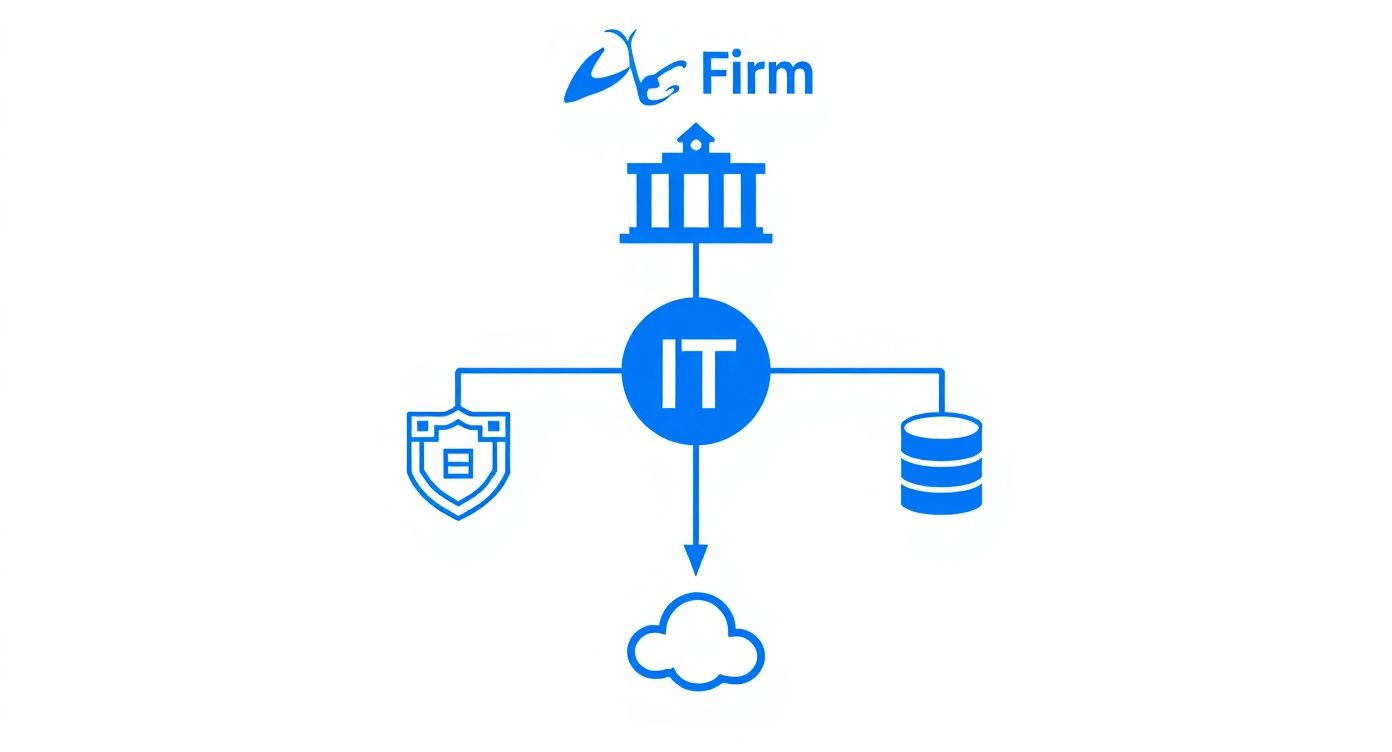
As you can see, it’s not about having separate security, cloud, and data management plans. It’s about weaving them together into a single, powerful strategy to protect your firm and help it grow.
Connecting Security to Compliance Mandates
Solid cybersecurity isn't just good business sense—it's a legal and ethical requirement. Accounting firms are bound by strict regulations, and your technology stack must be up to code. This is where having an IT partner who speaks your language is so crucial.
The FTC Safeguards Rule, for example, isn't a friendly suggestion. It's a federal mandate requiring you to develop, implement, and maintain a comprehensive security program to keep client data safe. Non-compliance can lead to hefty fines and audits.
A specialized provider does more than just install software. They map your entire IT infrastructure and its controls directly to these compliance frameworks. They help you:
- Document Security Policies: Create and manage the formal, written policies that auditors demand to see.
- Implement Access Controls: Enforce "least-privilege" access, ensuring staff can only view the client data they absolutely need to do their jobs.
- Prove Compliance: Generate the reports and log files needed to demonstrate due diligence during an audit, such as for a SOC 2 examination.
Knowing what the common vulnerabilities are and taking proactive steps is vital for protecting your firm's data. For a wider look at security basics, this guide on Cybersecurity for Small Businesses provides some great foundational insights.
Ultimately, the right IT partner translates complicated regulatory language into practical, technical solutions, dramatically lowering your firm's risk. The results speak for themselves. Firms working with managed service providers report an average 25% improvement in IT system uptime, a 30% reduction in security incidents, and a 15-20% decrease in compliance audit findings. This shift turns IT from a necessary expense into a strategic tool for managing risk and protecting your bottom line.
How to Choose the Right IT Partner
Picking an IT provider is one of the most important decisions you’ll make for your accounting firm. This isn’t about just finding someone to fix a broken printer; you’re handing over the keys to your clients' financial kingdoms. Not all IT companies are created equal, and a generic provider simply won't understand the high-stakes world of tax deadlines, specialized software, and the strict compliance rules you live by.
To make the right choice, you have to look past the slick sales pitch and really dig into the capabilities that matter for an accounting practice. The goal is to find a partner who feels less like a vendor and more like a true extension of your team—someone who gets your workflow, anticipates your needs, and is genuinely invested in keeping your firm secure and running smoothly. That means asking some tough, specific questions to weed out the generalists from the real accounting IT specialists.
Evaluating Industry Experience and Technical Expertise
Your first and most important filter should be experience with firms like yours. An IT partner who has never dealt with a crashed Lacerte or CCH Axcess environment in the middle of March won’t have a clue about the kind of pressure you're under. You need a team that knows your core applications inside and out, not one that’s learning on your dime.
When you're vetting a potential provider, ask for direct proof of their accounting industry expertise.
- Software Proficiency: Can they show you case studies or give you references from other accounting firms? Ask them to walk you through their experience supporting the exact tax, audit, and practice management software your firm depends on.
- Compliance Knowledge: How do they align their security controls with regulations like the FTC Safeguards Rule or SOC 2? They should be able to talk confidently about these requirements and show you exactly how their services help you check those boxes.
- Tax Season Readiness: What’s their game plan for tax season? Do they offer extended hours? Is there a dedicated team ready to jump on urgent issues that could otherwise blow up your filing deadlines?
A potential IT partner should be able to clearly explain how they handle the unique pressures of an accounting firm. If their answers sound generic, they probably don't have the specialized experience you need to protect your practice and keep it productive.
Assessing Security Posture and Certifications
Your firm’s reputation is built on trust, and a single data breach can shatter that in an instant. That makes the security credentials of your IT partner completely non-negotiable. You need a provider who takes security just as seriously as you do, with the formal certifications to prove it.
A critical credential to look for is a SOC 2 Type II certification. This isn't just a fancy piece of paper; it’s an independent auditor's stamp of approval, verifying that the provider has strong internal controls for security, availability, and confidentiality. More importantly, it shows those controls actually work consistently over time. It's the gold standard for any service provider handling sensitive data.
Beyond certifications, dig into their day-to-day security practices:
- Data Ownership: What happens to your data if you decide to leave? Get a clear, written policy that guarantees you maintain full ownership and can get all your data back without a fight.
- Onboarding and Offboarding: What’s their process for adding a new hire or, more importantly, letting someone go? They must have a rock-solid protocol to ensure a former employee’s access to firm data is cut off immediately.
- Incident Response Plan: Ask them to walk you through what happens during a security breach. How will they notify you? What are the immediate steps to contain the threat? How will they help you recover?
Choosing the right managed IT services for accounting firms is a strategic investment in your firm's future. By focusing on proven industry experience, robust security credentials, and transparent service agreements, you can find a partner who will not only protect your firm but also help it thrive.
Your Checklist for a Seamless IT Transition
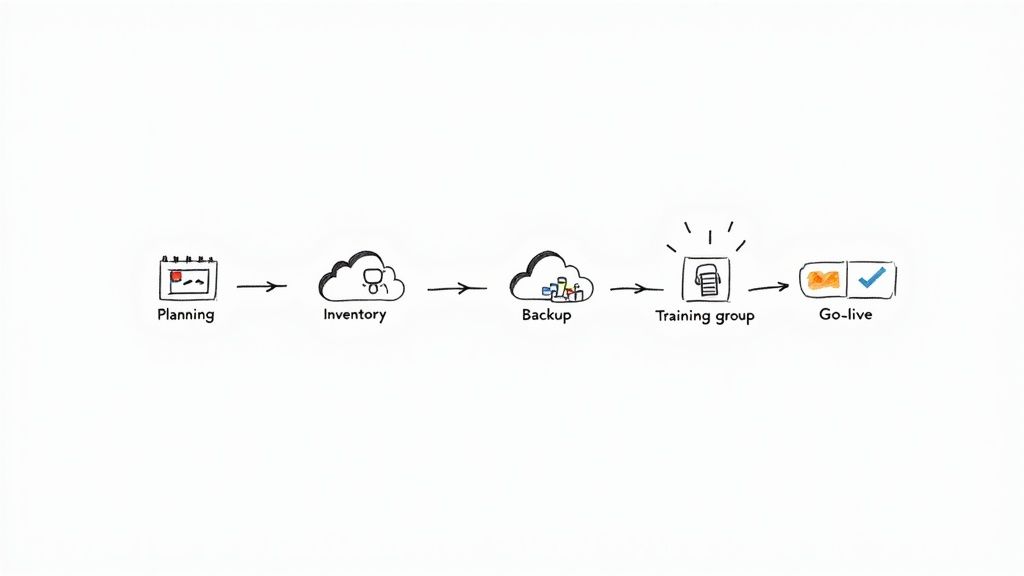
The idea of ripping out and replacing your firm’s entire IT system can be intimidating, to say the least. Client deadlines are always looming, so any kind of disruption feels like a huge risk. But here’s the thing: a carefully planned move to a new managed IT provider doesn't have to be a nightmare. With a solid game plan, the switch can be smooth and almost invisible to your clients.
Think of this as more than just moving data around. It’s a strategic project that hinges on clear communication and careful planning. A great transition keeps downtime to an absolute minimum, ensures every byte of client data is safe, and positions your firm to work more efficiently. The trick is to break the whole thing down into logical steps, making sure every detail is handled before, during, and after you go live.
This checklist will walk you through the process, giving you the confidence to navigate the move to a new IT partner without skipping a beat.
Phase 1: Pre-Migration Planning
The groundwork for a successful IT transition is laid long before a single file is ever moved. This is the discovery phase, all about documenting what you have and aligning on a strategy with your new provider. Skipping or rushing this stage is the #1 reason migrations go sideways.
First up, your new provider should perform a deep dive into your current setup. This means creating a complete inventory of every server, workstation, software license, and data location. It’s like creating a detailed blueprint of your firm's entire technology ecosystem.
Key steps you'll cover here:
- Data and Application Inventory: Getting a handle on all critical software (like QuickBooks, CCH Axcess, etc.), figuring out exactly where client files live, and identifying any quirky system dependencies.
- Timeline and Scheduling: Picking the right moment for the final switch. You’ll want to schedule it during a slow period—think after a major tax deadline or over a weekend—to avoid messing with billable hours.
- Defining Success Metrics: Agreeing on what "done" and "successful" actually look like. This includes hitting specific performance benchmarks for your core applications and getting confirmation that all security measures are in place.
Phase 2: Execution and Cutover
This is go-time. It’s when all the technical heavy lifting happens. Your managed IT provider will be in the driver's seat, but constant, clear communication is what keeps the project on track and everyone in the loop. The goal is simple: a clean switch with zero data loss.
Typically, your provider will build your new environment completely separate from your old one. This lets them test everything thoroughly without impacting your day-to-day operations. Once it all gets the green light, the final cutover is scheduled. Your team might experience a brief, planned outage while the last bits of data are synced over.
A well-executed cutover should feel like flipping a switch. One moment you're on the old system, and the next you're logged into a faster, more secure platform with all your familiar tools and data right where you left them.
Phase 3: Post-Migration Support
The job isn't done just because the new system is live. The first few days and weeks are crucial for squashing any minor bugs and making sure your team is comfortable and productive. A good IT partner will have a dedicated support plan ready for this exact period.
This final phase needs to include:
- System Verification: Right after the switch, the provider should be testing every critical application and workflow to confirm everything is running as it should.
- User Support and Training: Giving your staff simple instructions and a direct line to the help desk for any login issues or "how do I do this now?" questions.
- Decommissioning Old Systems: Once you’ve confirmed the new environment is stable and all your data is accounted for, the old hardware can finally be securely wiped and retired.
Following this kind of structured approach turns a potentially chaotic project into a predictable, successful upgrade. As you map out your firm's future, understanding the different cloud hosting managed services available is a great next step in your planning.
What's the Real Payback on Managed IT?
When you look at managed IT, it's easy to get fixated on the monthly fee. But to really understand the value, you have to look past the invoice and see the bigger picture. The true return on your investment comes from a mix of hard-dollar savings and massive gains in how your firm actually runs.
Think about it this way: moving away from the old break-fix model—where you're paying a premium for emergency repairs after something has already gone wrong—is just the starting point.
The most obvious payback? Slashing downtime. For an accounting firm, every hour your systems are down is an hour you can't bill, especially when tax season is in full swing. When your software crashes or you can't access client files, work stops, deadlines get pushed, and you risk damaging client trust. A good managed service provider (MSP) keeps those interruptions to an absolute minimum, protecting the revenue you'd otherwise lose.
Hard ROI vs. Soft ROI
To get a complete picture of the value, you need to look at it from two angles. First, there's the Hard ROI—the tangible, easy-to-measure financial benefits that show up on your profit and loss statement.
- ** predictable Budgeting:** Gone are the days of surprise, four-figure repair bills. You get a flat monthly fee, which makes financial planning a whole lot easier.
- Fewer Downtime Losses: Every hour your team stays productive is another billable hour captured. In fact, firms that partner with an MSP often report an average 25% boost in system uptime.
- Reduced Capital Spending: Instead of shelling out huge sums for new servers and hardware every few years, you shift that spending to a predictable operating expense.
But the story doesn't end there. Soft ROI covers the less tangible—but often more powerful—benefits that fuel your firm’s growth and sanity.
Soft ROI is what happens when you get your most valuable resource back: your time. It’s when partners can finally stop troubleshooting IT issues and start focusing on high-value client strategy. It's your staff working smoothly without constant tech frustrations.
The Guarantee: Your Service Level Agreement
This is where your Service Level Agreement (SLA) comes into play. An SLA isn't just a piece of paper; it's a performance guarantee. It’s a formal contract that lays out exactly what your provider promises in terms of uptime, how fast they’ll respond to a problem, and when you can expect a fix. It makes the value you're paying for completely transparent.
A solid SLA should spell out a few key things:
- Guaranteed Uptime: Look for a specific number, like 99.9% guaranteed availability for your critical systems.
- Response Time Metrics: This defines how quickly they have to acknowledge your ticket and start working on the problem.
- Resolution Time Goals: This sets clear targets for how long it should take to fully resolve issues of varying severity.
When you have a strong SLA, your investment in managed IT services for accounting firms stops being just another line-item expense. It becomes a strategic asset that you can count on. You’re not just paying for IT support; you’re making a measurable, performance-backed investment in your firm's productivity, security, and ability to grow. The real ROI isn't about spending less on IT—it's about empowering your firm to earn more.
Frequently Asked Questions
Even when you see the clear benefits, handing over your firm's IT is a big decision. Let's tackle some of the most common questions partners ask when they're thinking about managed IT services. My goal is to give you straight answers so you can make the right call for your firm.
What Does This Actually Cost?
Unlike the rollercoaster costs of calling an IT guy for every emergency, managed services work on a predictable monthly subscription. Think of it like a utility bill for your tech.
The price is usually based on a few things: the number of people on your team, how complex your current setup is, and which specific services you need (like advanced cybersecurity or detailed compliance reports). This approach gets rid of those surprise invoices and turns IT into a stable, budget-friendly operating expense instead of a chaotic capital one.
How Long Does The Transition Take?
A good migration plan is all about causing as little disruption as possible. The whole process—from the first look at your systems to the final switch—usually takes anywhere from a few weeks to a couple of months.
The actual "go-live" moment is almost always planned for a weekend or after hours. We do this to ensure there is zero impact on your billable time. Your new provider does all the heavy lifting, so for your team, the switch feels seamless.
Will We Lose Control Over Our IT Systems?
Absolutely not. Think of it this way: you're delegating the technical legwork while keeping full strategic control. You still own all your data and you're the one who sets the policies.
A good IT partner works with you, not just for you. They offer expert advice and clear reports so you're always in the loop. The whole point is to free you from the daily grind of IT headaches, not to take away your control.
The right managed IT partnership actually enhances your control by giving you better visibility and security. It empowers you to focus on strategy and growth, confident that your technology foundation is solid and secure.
Ready to protect your firm's data and boost productivity with a team that truly gets the accounting industry? Contact Armour Cloud today for a consultation on managed IT services designed for Phoenix-area accounting firms. Learn more at https://armourcloud.io.
Article created using Outrank


