
Private Cloud vs Public Cloud Control: Compliance & Control.

When compliance, control, and latency matter, the choice between a private cloud and a public cloud becomes strategic, not just technical. Organizations in healthcare, finance, and legal sectors face real consequences for getting it wrong, from regulatory fines to reputational damage.
In this guide you'll get clear comparisons, practical controls you can implement, and guidance for deciding which model fits your regulated business needs. Here I call out tradeoffs around security, compliance, performance, and management so you can act with confidence. Private Cloud vs Public Cloud Control is the focus, and by the end you will know what to ask your provider and which configuration reduces your compliance and operational risk.

Why control matters for regulated organizations
Control equals accountability. For HIPAA, SOC 2, and PCI regulated organizations, controlling where and how data is stored and accessed directly affects your ability to meet audit requirements. Private cloud and colocation let you maintain stronger physical and administrative controls, while public cloud offers speed and scale but shifts some control to the provider.
Key considerations decision-makers should weigh:
- Data residency and sovereignty, especially for patient or financial records
- Encryption at rest and in transit, and who manages the keys
- Access controls and privileged account management
- Auditability: logs, retention, and tamper-evidence
- Operational responsibilities, including patching and incident response
Private cloud control: what you get and when it matters
Stronger physical and administrative control
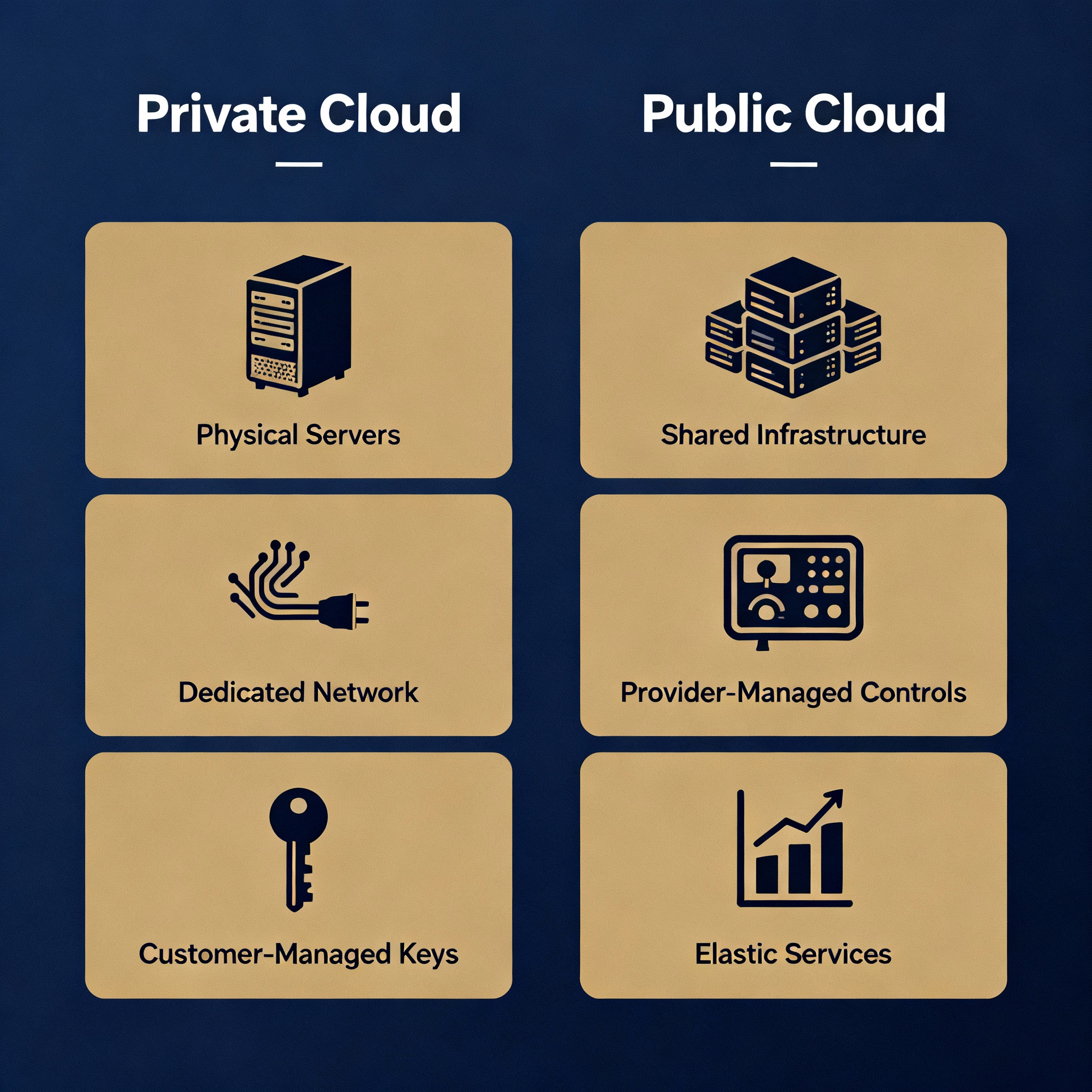
A private cloud or hosted private environment gives you exclusive compute and storage, which simplifies proof of separation for audits. You control network segmentation, firewall policies, and often key management.
Learn more about private solutions at our Private Cloud Hosting page: https://armourcloud.io/private-cloud-hosting/
Compliance advantages
Private environments make it easier to demonstrate HIPAA and SOC 2 controls because fewer shared tenancy variables exist. For many healthcare and legal clients, that simplifies risk assessments and reduces compensating controls.
Explore HIPAA-focused options: https://armourcloud.io/hipaa-compliant-cloud-hosting/
Performance and predictability
Because resources are dedicated, you see predictable latency and throughput, which is vital for VDI and clinical systems. If low-latency, high consistency, and deterministic performance matter, private cloud or colocation are strong choices. See Managed Virtual Desktops for options: https://armourcloud.io/virtual-desktops/
Public cloud control: where it helps and where it complicates things
Rapid scale and wide feature set
Public cloud providers offer unmatched elasticity and a broad services catalog. For non-sensitive workloads or bursty processing, public cloud is efficient and cost-effective.
Shared responsibility and reduced physical control
Control is shared. Providers manage the underlying infrastructure but you remain responsible for configuration, identity, encryption, and data governance. Misconfiguration is the top cause of cloud breaches.
If you use Microsoft 365 in a regulated environment, managed services can bridge gaps: https://armourcloud.io/microsoft-365/
Hybrid and multi-cloud: combine control with flexibility
A hybrid approach often hits the sweet spot: keep regulated data and critical apps on private or colocation resources, and use public cloud for analytics, dev/test, or scalable web services. Hybrid Cloud Solutions let you design the boundary and controls where you need them: https://armourcloud.io/hybrid-cloud/
Practical steps for a secure hybrid model
- Segment regulated workloads into a private environment with strict access control
- Use encrypted, audited connectors to public cloud analytics services
- Implement centralized logging and SIEM across clouds
- Standardize identity with conditional access and multi-factor authentication
How to measure control: a short checklist
- Who owns the encryption keys? If it is you, control is higher.
- Can you restrict physical access to hardware? Private hosting or colocation provides this.
- Are audit logs immutable and retained according to policy?
- Is there a documented incident response process tied to service-level guarantees?
Armour Cloud supports 24/7 managed IT and compliant hosting that helps you check these boxes. Learn about our Colocation options: https://armourcloud.io/colocation/
Implementing control: concrete technical recommendations
- Use customer-managed keys when possible, and document key rotation policies
- Enforce least privilege and conditional access for remote desktops and M365
- Harden endpoints and use managed VDI to centralize patching and data exfiltration controls
- Deploy email filtering and encryption to reduce phishing and data leakage risk: https://armourcloud.io/email-filtering/ and https://armourcloud.io/email-security/
- Run regular configuration audits and automated compliance checks
Cost and operational tradeoffs
Private cloud can have higher up-front costs and longer provisioning times, but it lowers audit complexity and data-risk premiums. Public cloud lowers time-to-market and operating costs at scale but increases the need for close governance and robust DevSecOps practices.
Summary
Choosing between private cloud and public cloud control depends on your regulatory obligations, performance needs, and willingness to manage security controls. Private cloud gives stronger direct control and simpler auditability. Public cloud delivers scale and speed but requires disciplined configuration management.
Get Started with Armour Cloud
If your organization needs a secure, compliant hosting partner in Arizona, we offer tailored private cloud, colocation, managed VDI, and M365 services with 24/7 support. Call (602) 529-3435 or request a consultation at https://armourcloud.io/contact/. Learn more about Secure WordPress Hosting and managed services at https://armourcloud.io/wordpress-hosting/.
FAQs
What is the biggest control benefit of private cloud over public cloud?
Private cloud gives you exclusive access to hardware, dedicated network segmentation, and greater simplicity for proving separation during audits, which reduces compliance complexity for HIPAA and SOC 2.
Can public cloud meet HIPAA or SOC 2 requirements?
Yes, public cloud providers can host compliant workloads, but meeting requirements depends on correct configuration, strong identity and key management, and documented responsibilities under the shared responsibility model.
When should we use managed VDI instead of local desktops?
Use managed VDI when you need centralized control over data and apps, consistent performance across locations, and simplified endpoint security. Managed VDI reduces data sprawl on employee devices. See Managed Virtual Desktops: https://armourcloud.io/virtual-desktops/
How do we protect email and prevent phishing in the cloud?
Combine advanced email filtering, inbound/outbound encryption, DMARC/DKIM/SPF, and user training. Armour Cloud offers email security and filtering options: https://armourcloud.io/email-security/ and https://armourcloud.io/email-filtering/
What are the first steps for migrating regulated data to a private cloud?
Map data flows, classify sensitive data, design network segmentation, establish key management, and run a pilot with logging and audits enabled. Engage your provider early to document controls for auditors.
Conclusion
Here's the thing, control is not binary. It is a set of decisions you make about where data lives, who holds keys, and how access is logged. For regulated organizations in Arizona and beyond, private cloud or colocation often reduces audit risk and delivers predictable performance. Public cloud remains valuable where scale and time-to-market matter. The best path is a deliberate architecture, strong governance, and a trusted partner that understands compliance.
Call (602) 529-3435 to discuss a compliance-first cloud strategy or request a consultation at https://armourcloud.io/contact/.
About Armour Cloud
Armour Cloud is a Phoenix-based provider of secure, compliant cloud hosting and managed IT solutions for regulated industries. Armour Cloud delivers high-performance infrastructure built on Arizona data centers, offering low-latency, HIPAA-compliant hosting with 24/7 support.
We specialize in helping healthcare, finance, and legal organizations protect sensitive data, meet compliance requirements, and modernize their IT with scalable, managed cloud environments.
Our Top Services:
- Colocation
- Managed Desktop-as-a-Service (VDI)
- Managed Microsoft 365 Services
- Email Security & Encryption
- Secure WordPress Hosting
- Private Cloud Hosting
- HIPAA Compliant Cloud Solutions
Ready to Secure Your Cloud?
📞 Call (602) 529-3435 or Contact Armour Cloud to get started with a free consultation.