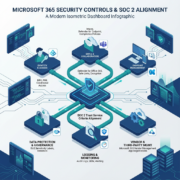
Managed Microsoft 365 Compliance Challenges: Practical Guide

Managing Microsoft 365 in a regulated environment is deceptively complex. You get the benefits of cloud productivity, but you also inherit responsibilities for data protection, retention, access control, and auditability. In this guide we’ll break down the most common pitfalls and practical fixes for managed microsoft 365 compliance challenges, so you can keep sensitive data safe, reduce audit friction, and maintain operational continuity.

Why Microsoft 365 Compliance Is Hard for Regulated Organizations
Microsoft 365 is feature rich, with built-in security and compliance tools. Here’s the thing, though: that richness creates surface area. When your organization is subject to HIPAA, SOC 2, PCI, or state privacy laws, gaps appear in configuration, governance, and monitoring. Common root causes are:
- Distributed responsibility between IT, security, and line-of-business teams
- Misconfigured retention, DLP, and access controls
- Shadow IT and unmanaged third-party integrations
- Weak or inconsistent identity and endpoint hygiene
If you’re evaluating public cloud vs locally managed services, remember that compliance isn’t automatic. Controls need design, documentation, and continuous validation.
Top Managed Microsoft 365 Compliance Challenges
1. Data Classification and Retention Policies
Organizations struggle to classify PHI, PII, and financial data consistently. Without clear classification, retention rules and legal hold policies get misapplied, which risks noncompliance and data loss.
Actionable step: Map common document and mailbox types to retention labels, then automate label application with sensitivity labels and DLP rules.
2. Identity and Access Management
Weak identity controls let unauthorized users access sensitive mailboxes or SharePoint sites. Legacy authentication and inadequate MFA posture are frequent culprits.
Actionable step: Enforce conditional access, require MFA, remove legacy authentication, and implement least-privilege admin roles using Privileged Identity Management.
3. Email Security and Phishing
Email remains the top attack vector. Compromised accounts can bypass controls unless advanced filtering and monitoring are enabled.
Actionable step: Use Microsoft Defender for Office 365 with layered email filtering, link protection, and targeted attack simulations. Complementcloud tools with managed email security for faster incident response.
4. Collaboration Sprawl and Shadow Apps
Guests, Teams channels, and external file sharing multiply exposure points. Third-party apps connected to M365 can exfiltrate data.
Actionable step: Establish an app governance program, restrict third-party app consent, and audit external sharing settings regularly.
5. Auditability and Evidence Collection
Meeting auditors’ evidence requests is time-consuming when logs, retention settings, and policies are scattered.
Actionable step: Centralize logging and enable retention for audit logs, use eDiscovery and advanced audit features, and automate evidence exports for recurring audits.
6. Misaligned Backup and Disaster Recovery
Assuming Microsoft handles all backups is a risky misconception. Native M365 retention is not a full backup strategy for accidental deletion or ransomware recovery.
Actionable step: Adopt a managed backup for Exchange Online, SharePoint, OneDrive, and Teams to ensure point-in-time restores and long-term retention.
How to Mitigate These Challenges: A Practical Roadmap
Governance First
- Create a joint governance team that includes IT, security, compliance, and business owners.
- Draft a simple control matrix linking policies to M365 capabilities.
Harden Identity and Endpoints
- Enforce MFA and conditional access policies.
- Roll out device management and conditional access with Intune for managed endpoints.
Configure Protective Controls
- Apply sensitivity labels, DLP policies, and encryption for email and documents.
- Enable Microsoft Purview features for records management and data lifecycle control.
Layered Email Defense
- Combine Microsoft Defender for Office 365 with managed email filtering and threat hunting to reduce time-to-detect.
- Implement DMARC, DKIM, and SPF records for domain protection.
Continuous Monitoring and Automation
- Use SIEM integration to centralize alerts and automate low-level remediation.
- Schedule regular policy reviews, simulated phishing, and access recertification.
Choose Managed Services Where It Counts
If you lack the internal bandwidth to operationalize these controls, a local managed provider can help. Armour Cloud offers specialized support for Microsoft 365 managed services, helping you implement policies, manage backups, and respond to incidents. Explore Armour Cloud’s Microsoft 365 Managed Services and Compliant M365 Email Service for tailored support.
- Managed Microsoft 365 policy design and enforcement: https://armourcloud.io/microsoft-365/
- Compliant M365 email and encryption: https://armourcloud.io/compliant-email-service/
- Layered email security & managed filtering: https://armourcloud.io/email-security/
- For regulated hosting and private cloud options: https://armourcloud.io/hipaa-compliant-cloud-hosting/
- If desktops must be locked down, consider Managed Virtual Desktops (VDI): https://armourcloud.io/virtual-desktops/
Best Practices Checklist for Compliance Officers
- Inventory all M365 workloads and data locations
- Classify data, then apply labels and retention automatically
- Enforce conditional access and retire legacy authentication
- Enable advanced audit and preserve logs for the retention period required
- Implement third-party backup for rapid recovery
- Regularly review guest access and app consent
- Run tabletop exercises and evidence-readiness drills quarterly
Summary
This guide outlines the most common pitfalls and practical fixes for managing Microsoft 365 in regulated environments. Focusing on governance, identity, data classification, layered email security, and managed services will reduce compliance risk and improve your audit posture.
Frequently Asked Questions
What are the most common misconfigurations that cause noncompliance in M365?
Misconfigured retention labels, open external sharing, legacy authentication, and missing DLP rules top the list. A governance-driven posture and periodic audits reduce those risks.
Do I need a third-party backup for Microsoft 365?
Yes. Native retention meets some needs, but third-party backups provide point-in-time recovery, ransomware rollback, and long-term archival options required by many compliance frameworks.
Can Armour Cloud manage my Microsoft 365 compliance requirements?
Armour Cloud offers managed Microsoft 365 services, compliant M365 email, and 24/7 support to operationalize controls and provide audit-ready evidence.
How often should policies and access be reviewed?
Policy reviews and access recertification should be at least quarterly for high-risk data and semi-annually for lower-risk systems, with immediate reviews after major incidents.
What is the role of conditional access in compliance?
Conditional access enforces where, when, and how users access resources. It is essential for enforcing MFA, restricting risky logins, and protecting sensitive mailboxes and SharePoint sites.
How do I handle third-party app risk in M365?
Implement app governance, restrict tenant-wide app consent, require security reviews for any third-party connector, and periodically audit granted permissions.
Ready for Practical Help
If your team needs hands-on support implementing these controls, Armour Cloud provides managed Microsoft 365 services tailored for regulated organizations. Call (602) 529-3435 or visit https://armourcloud.io/contact/ to schedule a consultation.
Conclusion
Managed Microsoft 365 compliance challenges are solvable with a structured approach. Start with governance, secure identities and endpoints, apply automated data protections, and add managed services where internal capacity is limited. That combination reduces audit friction, improves security posture, and frees your team to focus on core business outcomes.
About Armour Cloud
Armour Cloud is a Phoenix-based provider of secure, compliant cloud hosting and managed IT solutions for regulated industries. Armour Cloud delivers high-performance infrastructure built on Arizona data centers, offering low-latency, HIPAA-compliant hosting with 24/7 support.
We specialize in helping healthcare, finance, and legal organizations protect sensitive data, meet compliance requirements, and modernize their IT with scalable, managed cloud environments.
Our Top Services:
- Colocation
- Managed Desktop-as-a-Service (VDI)
- Managed Microsoft 365 Services
- Email Security & Encryption
- Secure WordPress Hosting
- Private Cloud Hosting
- HIPAA Compliant Cloud Solutions
Ready to Secure Your Cloud?
📞 Call (602) 529-3435 or Contact Armour Cloud to get started with a free consultation.